Showing posts with label Non-Fiction. Show all posts

Wednesday, March 04, 2026

Book Review [174] : Surrounded By Idiots

A beautiful 'Book Fair' was organised in this year's Exhibition (also called Numaish) in Aligarh in Feb. I bought about a dozen books in this fair. 'Surrounded by Idiots' by Thomas Erikson came as a highly recommended book by the shopkeeper. 


This book is basically a study on the personality traits/types and how to converse with them, how to manage them and how to deal with them. As per the book there are 4 types of persons:

    1. Red (Dominant, Aggresive, Egoist)

    2. Yellow (Extrovert, Talkative, Egotist)

    3. Green (Submissive, Quiet, Worker, Introvert)

    4. Blue (Perfectionist, Analytical worker, Introvert)

I don't know whether its correct to compartmentalise people or not but in a way this books gives certain ideas about behavioural aspects of people.

The title of the book is a kind of misnomer.

Wish you all a very happy Holi. May this festival bring lot of happiness and colour in your lives. 


Saturday, August 16, 2025

Book Review [173] : Moonwalking With Einstein

 As you age you start forgetting things that you used to remember clearly. It has happened with me multiple times. I used to remember/recall cricket scores of almost every match played by India in 1990s and 2000s but now I can't even recall who won MoM awards in last two Indian victories. I always wanted to know how our memory system works and how to sharpen it. I found this book 'Moonwalking With Einstein' while browsing and I read it and I found answers to few of my questions not all.

It's a good book and it talks about concepts like 'Memory Palaces', 'Mind Mapping', 'OK Plateau' etc. Written by Joshua Foer it says that The Brain is like a muscle and memory training is a form of a mental workout. Over time, like any other form of exercise, it will make the brain fitter, quicker and more nimble. Brain records everything to which it pays any degree of conscious attention, and that this recording is permanent.

The book talks about plasticity of brain. It says that the brain is a mutable organ, capable within limits of reorganising itself and readapting to new kinds of sensory input, a phenomenon known as neuroplasticity

Experts say that there is a limit on our brain to process information. We can only think about roughly Seven things at a time. Magical number Seven is the universal carrying capacity of our short term working memory (similar to cache of a processor). 

Sometimes we hit a plateau while learning a skill it means we are not improving any further. It happens with most of the people. The Secret to improving a skill is to retain some degree of conscious control over it while practicing. I.e. to get consistent feedback and to experience failing. 

What I think after reading this book pretty thoroughly is this that no technique will make you have Photographic Memory. What you actually need are Good sleep (7-8 hours), consciously observing/reading events/books and getting rid off consistent social media chirping and screen exposure.
A Highly Recommended Book (9/10)


Monday, November 25, 2024

Book Review [170] : Fooled By Randomness

I bought 'Fooled By Randomness' almost 8 years back from a shop in Bengaluru and it stayed in my bookshelf for those many years. This month i got a chance to read this book and i found it intriguing, confusing and radically important book in our chaotic world.


I found at times this book pretty boring and sometimes i felt that instead of giving 250 odd pages to it, the ideas could have been covered in less than 100 pages. The focal point of this book is about the role played by sheer random dice of fortune in our daily lives that we sometimes credit our skills and hard work. Nassim gives a large number of examples including the seminal example of infinite number of monkeys on infinite keyboards; there is a probability that some monkey will reproduce Iliad, Odyssey or even 'Fooled by randomness'. 
 
Another concept though very common is about 'Hindsight bias'. A mistake is not something to be determined after the fact, but in the light of the information until that point. Another linked concept is 'Survivorship bias' - We do not take account for losers in our sample size. The survivors path decide everything for make gurus though they might have been lucking in surviving.
 
In nutshell its a good book and should be read as it triggers good ideas in our brain. Sometimes or may be always its better to be a fooled by randomness. Sometimes it breaks the stalemate. In the end it is always a better practice to be a stoic and do not let randomness compromise your dignity.
 
Highly Recommended. 

Sunday, October 20, 2024

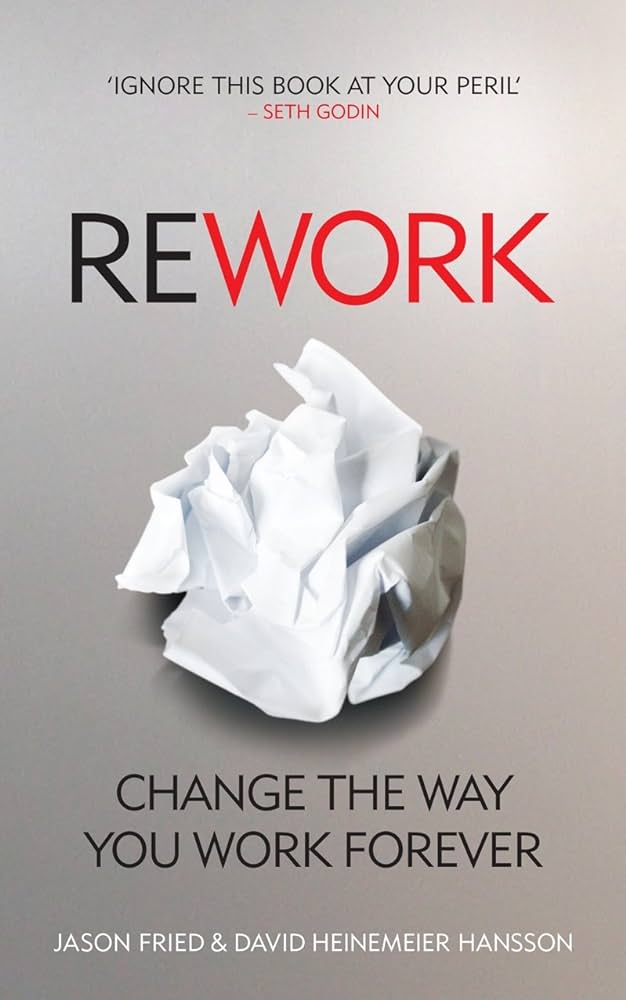
Book Review [169] : Rework

'Rework' is a beautifully written work by Jason Fried and David Hansson. It's such a lovely read that you can finish it within couple of days if not in a day.

There are pretty good few lessons from this book.

Workaholics are not Heroes - It sounds pretty logical today, but I was kind of one 10 years back and I consider to be that even today. In my first job way back in 2005 I used to consider those people who leave office by 0630 PM as losers and mediocre and whose who burned midnight oil as actual geeks. This is pure poison and basically it kills good office culture. It should be avoided and this book underscores this point really well.

We should take responsibility of bad news and failures. We should not let the rumour mongers decide our response to failure.

Don't be a fake. No body likes plastic flower. Be natural and be spontaneous.

We need to know how far we can push some one. This is the thing I read few decades back from some Australian Cricket player when he talked about Steve Waugh leadership. He wrote that if Steve asks us to hit our head to the wall, we will do it without thinking twice. This is one of the most fundamental traits of a good leadership.

Perfect time never comes so don't defer your decisions waiting for that moment. Every decision made is a progress.

The single most important thing that is killing our productivity is interruption - Calls, Social Media etc. The one who can get long slot of free time can immensely improve one's productivity. 

Almost every point in this book is common sense and we all know about it but we hardly follow it. This book is about reworking on those points.

Highly Recommended (10/10)


Saturday, May 30, 2020

Book Review [159] : Let Me Say It Now

'Let Me Say It Now' is an autobiography of highly respected and decorated Indian Police Service Officer (now retired) Mr. Rakesh Maria Sir. During my training in SVPNPA in 2016 i saw him at lunch but was not lucky enough to interact with him. But i knew at that point of time that Kay Kay Menon did his role in the movie Black Friday made on Bombay attacks of 1993. He was cult hero.

Three main incidents or rather tragedies defined Maria's highly decorated Police career - Bombay blast and brilliant detection of conspiracy behind it, 26/11 Attacks and Sheena Bora case. Bombay blasts detection made him a great hero, 26/11 attacks and various associated insinuations reduced some sheen and the Sheena Bora case controversy applied sudden brake to his career as he himself suggests in this book.

The events surrounding 26/11 attacks forms major part of this book. The heroic sacrifice of Mumbai Police is well known and well documented. Maria  himself got overwhelmed once when he asks Ajmal Kasab to say Bharat Mata Ki Jai and Kasab says it. His attention to the minute details of planning and team management is something even very great leaders can envy. He was unfairly attacked by fellow Police Officers for his actions during 26/11 attack. He was made incharge of Control Room by CP Mumbai and he was responsible for mobilization of force on ground and co-ordination among various teams. He regrets even now that he was not on ground during those attacks. He regrets for not dying in those attacks.
He became Commissioner of Police Mumbai in 2014. During his last few weeks as CP Mumbai he was unfairly attacked by media for allegedly botching up Sheena Bora murder case. He was unceremoniously shunted from the post of CP Mumbai to DG Homeguards in Sept 2015. He retired in Jan 2017. 
He himself writes that Transfers and Postings are prerogatives of the State. There are no ill feelings. 
Overall its a very nicely written book covering various aspects of legendary Police Officer Rakesh Maria.
Highly Recommended (9/10)

Monday, January 06, 2020

Book Review [158] : Rama and Ayodhya

From my childhood i have heard and read a lot of stories about Bhagwan Ram and Krishna. Its indeed a painful experience to see one's holiest shrines topped by religious structures of another faith. Mahmud Ghazni destroyed many such great temples including Shri Krishna Temple at Mathura and Somnath Temple in Saurashtra. Since then and till the decline of Mughal empire it never stopped. Many many temples were destroyed and over those temples many Mosques were erected; Kashi, Mathura are two such prominent examples. Destruction of Mathura and Kashi Vishwanath temples are very well documented. 
Shri Ramjanmbhoomi - Babri Masjid dispute is one of the oldest running disputes over a religious place anywhere in the world. Its well known that Ayodhya is the birthplace of Bhagwan Ram but no body knows the exact location where Ramji was born. Babri Masjid was located at a place which was very sacred to Hindus and there were hardly any Muslim habitation there. Who would built such a Mosque there at a mound which is surrounded by sacred Hindu shrines. Meenakshi Jain's Rama Ayodhya answers many such questions.
The worship of Rama is not a recent phenomenon as the leftist intellectual tell us. More than 2000 years old Bhagwan Ram artifacts have been found. There are huge number of literary evidence about Bhagwan Ram. The excavation done by ASI at disputed structure revealed many artifacts and structures which can only be found in Hindu shrines/temples. The Ayodhya site had been in occupation for more than 2000 years and the last prominent temple was built by Gahadavala King. Why would Babur built a Mosque at a place which was not politically important! Delhi and Agra were more important. Ayodhya was religiously more important. Perhaps thats the answer.
A civilization that does not acknowledge the crimes committed by its vanquishers and instead  celebrates their acts is destined to enjoy infinite intellectual slavery, inferiority complex and defeatism. 
Highly Recommended book for those who want to wake up (10/10)

Thursday, November 21, 2019

Book Review [157] : Amritsar - Mrs Gandhi's Last Battle

Amritsar - Mrs Gandhi's Last Battle by Mark Tully and Satish Jacob is a brilliant book on Operation Blue Star. 
Mark Tully was known to almost every news loving Indian specially in 1980s and 1990s. Operation Blue Star left a deep scar on India's soul and created a lot of bad blood between brothers - Sikhs and Hindus. How Mrs Gandhi appeased Bhinderwale and how he became a threat to her in less than a decade.  
The Golden Temple or Hari Mandir was built in the middle of Sarovar by fifth Guru Arjun Dev in 1589. Foundation stone was laid by Mian Mir from Lahore. His successor Guru Hargobind built the other shrine within Temple Complex - The Akal Takht. Ahmad Shah Abdali blew up the Golden Temple and filled the holy pool with the carcass of slaughtered cattle. Akal Takht was also razed to ground. The Temple was rebuilt later and it reached its zenith during Maharaja Ranjit Singh era. After Independence the identity politics nurtured the ground for the communal politics of Bhinderwale. The reign of terror was unleashed in Punjab and many hundred people were killed in that madness. Finally Indian Army stormed the Temple Complex on 5th June 1984 killing the extremists hiding in the Temple Complex. The Akal Takht and Golden Temple suffered damage. Indian Army suffered about 300 casualties. By 7th June the Temple Complex was sanitized. The Sikh soldiers mutinied but they were checked. The madness did not stop at this Operation. Madness caused the killing of Mrs. Gandhi. Finally Rajiv Gandhi was able to reconcile the Sikhs and the festering problem was put to an end. Its a must read book. It talks in detail about the root cause of Punjab Problem, How Mrs Gandhi failed to tackle it and in the end caused Operation Blue Star and lost her life. 
Highly Recommended (9/10).

Saturday, August 05, 2017

Book Review [151] : Al Beruni's India

Every student of Indian History must have heard the name of Persian Polymath Al Beruni (973 - 1048 AD), this person had done more serious work on India than perhaps any one else before the arrival of European orientalist. He was the scribe cum companion of Mahmud of Ghazni. He had written very serious works on India and Tarikh Al-Hind is his magnum opus. 

His work on India was translated by German orientalist Dr. Edward Sachau (1845-1930). In this book i.e. Al Beruni's India Dr. Sachau had covered almost all comments on India by Al Beruni. Al Beruni had written on almost every aspects on Indian civilization from religion to language, society to politics and from Maths to science. He had vicious hatred towards Hindus in general and at many places call them perverts, liars and cunning. At some places he did give credit to Indians and praises Hindu Shahi Kings of Kabul valley fully and regret their demise. Surprisingly he did not mention Buddhism much in his book though he writes that Buddhists and Hindus hate each other but they are one with respect to their attitude towards foreigners.

Insularity of Hindus
He writes that on the difference between Hinduism and Islam and general attitude of Hindus towards foreigners :
·   Hinduism is totally opposite to Islam. Among Hindus there is very little dispute about theological topics and even if the dispute arises they will utmost fight with words but they will never stake their soul or body or their property on religious controversy. Their entire fanaticism is directed against those who do not belong to them i.e. against all foreigners. They call them Mlechha or impure and forbid having any connection with them. They think any connection would impure them. Hindus consider as impure anything which touches the fire and water of a foreigner. Once polluted they don’t welcome the polluted again in their fold. They are not allowed to receive anybody who does not belong to them, even if he wished it, or was inclined to their religion. Aversion to foreigner is not only a trait of Hindus but it is common to all nations towards each other. 

     He furthers writes that:
    Hindus consider all knowledge come from them and all other people and nations are ignorant and barbarians.

   Lack of Scientific approach
   Al Beruni further writes that Indians lack methods of strict scientific deductions. The science of Hindus is in a state of utter confusion and devoid of any logical order and always appease to the sentiments of crowd and it has inherent religious dogmas in it. Hindus mathematical and astronomical literature is like a mixture of pearls and dung and both are equal in the eyes of Hindus since they cannot raise themselves to the methods of a strictly scientific deduction. In Greeks one can find philosophers like Socrates who refused to appease dogmatic people. He did not call the star gods and opposed Idolatry for which he was condemned to death.

History
Al Beruni says that the famous idol of Hindus at Multan was dedicated to sun and was made of wood and covered with red leather. Huen Tsang had also mentioned about this temple. It was called Aditya and was very much worshipped. Muhammad bin Qasim did not break this Idol as it was a flourishing trade center and wealth had been accumulated. In mockery he hung a piece of cow’s flesh on its neck. On the same place a mosque was built. When the Karamatians occupied Multan, Jalam Ibn Shaiban broke the idol in pieces and killed its priests.
The Idol of Thaneshwar was made of bronze and Al Beruni says it is lying in the hippodrome in Ghazni.
Hindu Kings of Turkish origins ruled Kabul. The first such King was Barahatakin. The last such Hindu Turkish King was succeeded by his Brahmin minister. Anandpal, Trilochanpal were the last of the rulers. Al Beruni praises Hindu Shahi Kings. They did what was good and right and were men of noble bearing and noble sentiment.
Mahmud of Ghazni destroyed the Shiva Linga of Somnath. The upper part was broken. Parts of Idol were installed before the door of the Mosque of Ghazni on which People rub their feet to clean them from dirt and wet.
These were the reasons why Hindus hate Muslims according to him.

 Hindu Customs
About the Hindu customs Al Beruni says that they differ from Muslims to such a degree that they appear to us monstrous. If any custom of Hindus resembles Muslim custom it has certainly just the opposite meaning. Hindus do not cut their hairs and Hindus do not eat Cow meat. In washing Hindus begin with their feets and then they reach their face. In all consultations Hindus take the advice of women. They do not ask permission to enter a house but when they leave it they ask permission to do so. He calls Hindus perverts and praises Islam for abolishing these habits in part of India where People had become Muslims. He further says that the greediness of the ignorant Hindu Princes for gold making does not know any limit. They can kill even the innocent children if the kill is required to make gold. The science of Alchemy should banish. Hindus have firm belief in charms and incantations. In general Hindus are liars.

Geography of India
He says that Kannauj is in ruins. He says the Kashmiri people are very insular. They hardly allow outsiders to enter their country though they allowed Jews to enter their territory.  The Gilgit region was ruled by the Turks. The king has the title Bhatta Shah. The capital of Kashmir suffers from the inroads of these Turks. He mentions Rameshwar as the southern tip. Setubandha is further south. Setubandha is the dike of God Rama that he builds to connect India to Lanka. His idea about Indian geography is very detailed and he mentions almost accurately all rivers, towns of India.

Religion/Astronomy and Cosmology
Very detailed take on Hindu religion, astronomy and cosmology. He quotes Brahmagupta in much detail.  He does not say about untouchability though he talked about caste system and the inherent hierarchy. The sudras were not allowed to hear Vedas. He mentions that there is a tree in Prayag from which Brahmans and Kshatriyas commit suicide by throwing them in the river from that tree.

This is a great work on India and its a shame that we did not write such books on our tormentors and never tried to learn their ways, their strengths and their weakness. For this insularity we paid the price in medieval period.
Highly Recommended (9/10)

Sunday, July 16, 2017

Book Review [150] : Jai Somnath

6 months a very long break in a kind of unbroken sequence of 149 book reviews over a period of 10 years. Sorry for this break though i enjoyed this break and was engaged in some serious actions in field.
I read 'Jai Somanth' in first week of July 2017 and its been a painful read. Indians are the rare people who rejoice in their defeats and that perhaps explains the title of the this book by eminent freedom fighter and writer Shri K M Munshi. Before reading this book i had read 'Somnatha - The many voices of history' by Romila Thapar. In this book Ms Thapar debunks the claim that Mahmud Ghazni destroyed the temple of Somnath on grounds of religion and he attributes only economic reasons behind his raid. I completely disagree with Ms Thapar on this. If economic reasons were the only reasons then why the Idol was destroyed and why its pieces were placed below the stairs of Ghazni mosque. What were the reasons behind destruction of Mathura temple, Multan sun temple and many more temples. These facts are well documented by his scholar companion Al Beruni.

'Jai Somnath' is a painful story of the sack and destruction of Somnath Temple by the hoards of Mahmud of Ghazni. The King of Prabhas Pattan Bhimdev fought really bravely but he was outmatched by Mahmud in resources and in numbers. The Indians though fought valiantly were undone by the traitors who helped Mahmud to open a hidden tunnel giving access inside the temple 'fortress'. What followed was gory trail of genocide, destruction of Shiva Idol and temple, enslaving of civilians and loot which he carried on the backs of camels and horses back to Ghazni. 
Many Indians helped him in this daring raid. But there were Indians who fought even better than the likes of Leonidas at Thermopylae. A few hundred strong clan of Chauhan Rajput Ghogha Baba fought like titans against the more than 50,000 strong barbaric hoards of Mahmud.
In a way, Justice was done when this temple was restored after Independence. The force of destruction can never decimate the spirit of truth and creation. But the most important point to ponder is that why we allowed these invaders to defile our country time and again. Perhaps V. S. Naipaul was right when he says 'The world is what it is; men who are nothing, who allow themselves to become nothing, have no place in it'.
Highly Recommended (9/10)

Sunday, January 08, 2017

Book Review [149] : Vengeance

I have seen Steven Spielberg 'Munich' about half a dozen times and never got bored. Eric Bana has simply immortalized the role of Mossad agent Avner in this flick. This movie is based on true story of Operation 'Wrath of God' launched by Israel ( and documented by George Jonas in his book Vengeance) to avenge the death of 11 Israeli athletes brutally killed by Black September terrorists during Munich Olympics of 1972. I was looking for this book 'Vengeance' for a long time but could not buy it because its pretty expensive about 900 bucks on Amazon. I got fortunate this year and i found it in the Police academy and i finished it in 3 days without a break.
The book starts with the story of Avner (changed name) and his training. He was a Sabra (i.e. born in Israel to Jewish parents) and son of a Mossad agent. He was chosen by Mossad chief Zvi Zamir and Major General Ariel Sharon to lead a 4 member strong team to kill 11 terrorists responsible for Munich massacre. He was asked to take the operation by Prime Minister of Israel Golda Meir herself. The book goes almost on same line as the movie and varies only in dramatization of certain killings. The team had 5 members - Carl the cleaner, Steve the driver, Hans the forger, Robert the explosive expert and Avner the leader. The team was given complete freedom and full financial resources but the team had to break off all the associations with the Mossad and legally it was on its own so that Israel can deny any responsibility in case of any mishap. 
The team was able to kill 8 terrorists out of 11 names given to them though they could not kill Ali Hasan Salameh - the master mind behind Munich massacre, Abu Daoud and Dr Wadi Haddad. Carl, Robert and Hans were killed in this 3 year long operation and the mission was called off in January 1975.
The book records in detail the psychological impact the mission had on its members and also underscores the fissure between Yekke Jews and Galician Jews. The Yekke Jews were mainly from the western Europe and were rich and sophisticated while the Galician Jews came from Eastern Europe and were tough and accustomed to the ghetto life. The top echelons of Mossad and Israel Army were dominated by the Galician Jews and they did not consider Yekke Jews martial material. Avner had a Germanic ancestry and hence a Yekke though Sabra and in the end he was given rather very poor treatment by the Mossad despite of his brilliant leadership.
I really like the definition of terrorism given by the writer. "Terrorism is not defined by the political aims but by the means to achieve it".
Highly Recommended (10/10)

Thursday, January 05, 2017

Book Review [148] : Ancient Bundelkhand

I am a Bundelkhandi by heart and in deep love with its people, culture and history. In my childhood i read brave and chivalrous stories of Alha, Udal, Pithora (Prithvi Raj Chauhan), Sarandha, Champatrai and Chhatrashal and they still make a significant part of yours truly.
This book 'Ancient Bundelkhand' by K K Shah is a nice work on the religious and social history of Bundelkhand specially on a subject which has very few takers. Bundelkhand is a historic land in central India bounded by Yamuna in North, Chambal in West, Narmada in South (And like all definitions this is also disputed one). It consists of following districts - Banda, Chitrakoot, Hamirpur, Jalaun, Jhansi, Lalitpur and Mahoba in Uttar Pradesh; Datia, Tikamgarh, Panna, Chhatarpur, Sagar and Damoh in Madhya Pradesh. Its population density is about 350 which is less than half of the population density of Uttar Pradesh and perhaps because of this the Uttar Pradesh part of Bundelkhand is very much a neglected region.
Bundelkhand is named after Bundela clan of Rajputs who were ruling this region when Britishers came. According to bardic tradition the founder of Bundela clan sacrificed his blood to Vindhyavasini Devi. From one of his drops (Bund) a child came into being with the blessing of the Goddess. The Goddess asked him to found the Bundela Kingdom. This region is also known as Jejakabhukti and its Brahmans and Baniyas call themselves as Jujhotiyas.
Many Historians including writer K K Shah believe that this region was a heavily forested region ruled by tribals - Shabaras, Pulindas and Gonds during pre Mauryan period. The only Ashokan edict that is found in this region is located at Gujara near Jhansi. After Mauryas this region came under Guptas and they built some great temples at Eran, Deogarh etc.
Bundelkhand is unique in many aspects. The Varahaavtara of Vishnu is a unique gift of this region. So many temples have been found dedicated to Varahaavtar. The Gupta temple of
Deogarh is the earliest example of Panchayatana style of temple architecture. According to traditions Sage Ved Vyas was from Kalpi (Jalaun district) and he composed Mahabharat here only. Eran has many inscriptions dedicated to Satee worship. The trident, the most characteristic weaspon of Lord Shiva, finds depiction in the pre-historic rocks paintings of Bundelkhand. The cult of Kapalikas was also prevalent in the region as recorded in Prabodh Chandrodaya by Sri Krishna Mishra in Chandellas court.
Guptas were succeeded by Rashtrakutas and Gurjara Praiharas and by 9th century Chandellas came into power. Under the reign of Chandellas this region flourished in all aspects. The Chandellas were great fighters and temple builders. They also built big tanks to moderate the drought prone condition of this region. The great temples of Khajuraho were built by Chandellas. The Chandella power was weakened by invasions from north and it came under Delhi Sultanate in 14th century though this control was weak. But Mughal period saw Bundelkhand losing its independence rapidly. In late 17th century, Chhatrashal rebelled against the Mughal Emperor and Bundelkhand again became an Independent state after "serfdom" of past 300 years. People of Bundelkhand are gentle but freedom loving and are proud of its history and traditions.
Bundelkhand has been a drought prone region since earlier days. In recent times crops failed in 1867, 1869, 1872 etc. In 1893 it saw heavy flood. Population declined by 11% between 1891 to 1901.The situation is more or less the same and people prefer to work outside this region as agriculture is a gamble here.
Recommended (7/10)

Friday, December 30, 2016

Book Review [147] : Before And After

'Before And After' is an autobiography of Shri B N Lahiri (Indian/Imperial Police Officer) who was one of the first IP Officers selected through competitive exam held for the first time in India in Dec 1921. Indians were debarred from direct recruitment to IP until 1921. Shri B N Lahiri started his IP training in 1922 when he joined 11 other IP Trainee officers at PTC Moradabad. He felt lot of subtle discrimination at the hand of his fellow probationers as he was the only Indian in 12 men strong batch. IP was heavily dominated by Britishers unlike ICS. In ICS about 50% officers were Indians by 1946 this percentage was just 25% in case of IP. B N Lahiri later became the first Indian IGP of UP Police and lived a long life after retirement. 
He writes that Police Officers should focus on discipline, control, leadership and frequent checks and inspection of their men and material. He should be always on move, meeting people and his men. He should be perceived as person with courage and strong morals. He should be able to defend his men at all cost if they have done no wrong and should punish heavily if they are found doing wrong. Discipline is the bedrock of any Uniform service and Police is no exception. The mediocrity and inefficiency creep in when senior police officers start bending themselves before politicians and others for sake of favors and start influencing bonafide decisions of their subordinates for the benefit of their 'benefactors'. 
He also talks about degrading morals and character of Indians in general. The lack of morals and punctuality is gradually sapping the foundation of our cultural ethos. We lack faith and courage in our own convictions and this further creates doubts in our people. The problems of Police can only be fixed by the firm and strong initiatives of its leaders otherwise it can only become worse.
He also mentions that in British period the IP officers were prohibited from mingling with subordinate officers (i.e. DySP etc) on equal footing and the presence of Subordinate officers were banned in IP Officers Mess. He also talks about the poor imitation of IP ceremonial dinner during British period. In the parade we have simply replaced King Emperor with Indian President, everything else remains same. Unlike only 3 Ceremonial Dinners in entire IPS training these days, in his days there were 5 dinner parades every week. He also mentions the institution of bearers that still plays a key role in training of IPS Officers.
This book also includes anecdotes involving various cases he was involved in as well as those involving Pundit Nehru, Lal Bahadur Shastri and Govind Vallabh Pant. B N Lahiri was the IGP of UP Police when UP Police and PAC were granted colors by Pundit Nehru in magnificent parade held at Lucknow led by Ghamandi Singh (IPS) and Avtar Narayan Kaul (then UP PPS) in 1952. 
This book was suggested by Librarian of Dr. B R Ambedkar Police Academy, Moradabad (formely PTC Moradabad), the same center where this legendary officer B N Lahiri underwent his training in 1922 and i reluctantly accepted his advice. It was a very good advice. I am really feeling very good to share the same PTC premises as shared by legendary officers of his level.
Highly Recommended (8/10)

Thursday, December 29, 2016

Book Review [146] : Jharokhe Se

'झरोखे से ' श्री अवतार नारायण कौल द्वारा लिखी गयी पुलिस विभाग पर एक प्रासंगिक पुस्तक है।   श्री अवतार नारायण कौल ने उत्तर प्रदेश पुलिस सर्विस सन १९५२ में ज्वाइन की तथा सन १९८६ में  पुलिस महानिरिक्षक के पद से सेवा निर्वित हुए। यह पुस्तक महोदय के संस्मरण के रूप में है।  उन्होंने काफी पुलिस केस हल किये तथा कई कानून व्यवस्था  की समस्यायों का निवारण किया। यह पुस्तक पुलिस अधिकारियों समेत सभी रैंक्स के लिए बेहद उपयोगी साबित हो सकती है बशर्ते किताब में उल्लेखित बिन्दुओं पर गंभीरता से विचार किया जाये।  
He appeared in Civil Services Examination in 1951 but was not given good marks on account of his giving preference to IPS over IAS (as he claims), so he joined UP PPS as DySP in 1952 and completed his training at PTC Moradabad. He later became IPS (after promotion) and retired as IG in 1986. 
Shri Avtar Narayan Kaul had solved main important cases including the gory Kheria murder case of 1957 in which a house servant raped and killed the wife of Squadron leader Kamath posted in Agra. He also killed their daughter and looted properties worth lakhs. He showed astute leadership and fine investigating skills to crack this case that had made entire Indian Military nervous. The leadership he showed when he was posted as SP of Mathura after the brutal murder of previous SP of Mathura by an angry Constable in his office in 1963 was simply exemplary. 
He spent major part of his career in western UP and defused many incidents of communal frenzy. The cutting of telephone wires to allow the passage of Tazia procession in Muradabad in 1968 was his brain child. This defused the volatile situation created by lakhs of Muslims who did not want to bend their Tazias below those wires and had gathered at that place blocking everything. Police Officers need to show such ingenuity more often.

He writes that good relation between SP and DM is an absolute must for proper maintenance of law and order in district. They should give their ego a good toss and work for the district instead of inflating their false egos.
Highly Recommended (8/10)

Tuesday, December 27, 2016

Book Review [145] : Meditations

'Meditations' written by Roman Emperor Marcus Aurelius (121 - 180 AD) in Greek is generally considered a great work of western philosophy. Marcus Aurelius was much influenced by Stoic philosophy that was prevalent in Rome in that era. Though i am not much impressed by this book and read it only because it features among great books of all time. This book contains advises and directions to live a meaningful life.
I love this part from the book when Marcus says "Stop drifting. You are not going to re read your brief comments, your deeds of the ancient Greeks and Romans, the commonplace books you saved for your old age. Sprint for the finish. Write off your hopes and if your well being matters to you, be your own savior while you can".
Read if you are really interested (5/10)

Thursday, December 22, 2016

Book Review [144] : Sapiens - A Brief History of Humankind

'Sapiens - A Brief History of Humankind' by Yuvan Noah Harari is one of the seminal books that has come out in last few years. In this book Harari explores the history of Humankind from the genesis of Genus Homo to the possible advent of Super Humans.
Humans first evolved in East Africa about 2.5 million years ago from genus of apes called Australopithecus. About 2 million years ago some of these Humans migrated to settle vast areas of Europe, Africa and Asia. Humans in Western Asia and Europe evolved into Homo Neanderthalensis, in East Asia they evolved into Homo Erectus, Homo Rudolfensis in East Africa among others. 
Homo Sapiens evolved from humans in East Africa about 200,000 years ago and by 70,000 years ago they spread out to rest of the world. By 30,000 Neanderthals of Western Europe became extinct and by 13,000 years ago Homo Floresiensis also became extinct and Homo Sapiens became only surviving Human species. Homo Sapiens played a 'stellar' role in destroying the pristine flora and fauna of the world and colonizing even the remotest places. They changed the ecosystem where ever they went. Red Indians, Maoris, Aborigines etc were perhaps the first colonizers of America, New Zealand and Australia. 
The Homo Sapiens ability to communicate and organize themselves in bigger groups made them distinct and powerful from the other Homo species and this enabled them to outsmart all other species. An average Homo Neanderthal can defeat an average Homo Sapiens on any given day but an Army of Homo Sapiens can never be defeated by an Army of Homo Neanderthals. No one knows for sure how Homo Sapiens got this unusual gift, was this random selection by Nature or was this a design by providence, no one knows. Harari has termed this as 'Cognitive Revolution' It happened about 70,000 years ago. This was followed by Agricultural Revolution about 12000 years ago and the current age of Industrial Revolution that started about 400 years ago. These three revolutions have made Homo Sapiens the master of this Planet and are daring to colonize other planets.
Harari also talks about various 'myths' like religions, companies, nations etc envisaged by Humans to create different kinds of organizations in order to keep Homo Sapiens organized and ensuring their lives full of meaning. He also mentions in details about the credit revolution that enabled the small peninsula to conquer the entire world. How Spain was able to destroy mighty Aztecs and Incas and how a small company was able to conquer India, he has tried to explain this. Its a very fluid and interesting read.
Highly Recommended (10/10)

Tuesday, November 15, 2016

Book Review [143] : Elon Musk - Tesla, SpaceX, and the Quest for a Fantastic Future

'Elon Musk - Tesla, SpaceX, and the Quest for a Fantastic Future' is a brilliant biography of South Africa born American entrepreneur Elon Musk who is the primary force behind
Space-X and Tesla. To be honest, i have heard the name of Elon Musk but did not know the kind of projects he is leading before reading this book. Elon aims to setup human colonies on Mars and to  make humans an inter planetary species. Elon founded a series of technology companies based out of Silicon Valley from Zip2, Xe.com, Tesla, Space X, Solarcity etc. Elon Musk as the book suggests is an actual Tony Stark. This book covers in great details the story of Elon Musk, the challenges and adversities he faced in making his dreams come true. Steve Jobs died few years back, thank God we have Elon Musk to continue the flame of innovation burning.  
To compete with the entrenched organizations like Boeing and Lockheed Martin and countries like Russia and China in the risky and expensive field of Space exploration is a huge deal and Space X has not only competed but successfully delivered Falcon rockets and Dragon Capsules that can deliver the payload to Space Stations and come back safe to Earth to be used in another cycle.
Electric Car concept is also not a new concept but Tesla cars are major breakthrough as these are not inefficient   and expensive cars but are highly efficient and spacious cars that can hit 100 kmph in less than 10 seconds. On a single charge the Tesla car can run 800 km without any break. This is a major breakthrough. Elon Musk is also building Charging stations highway that can charge these cars for free thus making environment safe and clean. I plan to buy Tesla once it is launched in India and if it meets my budget. 
Its a must read book. 
Highly Recommended (9/10).

Monday, October 24, 2016

Book Review [142] : Lincoln

Abraham Lincoln (12 Feb 1809 - 15th April 1865) was without any doubt the greatest leader of America. Born in a very humble family and without any formal education he went on to become the greatest President of United States of America. 'Lincoln' is a biography of this great man written by Pulitzer awardee David Herbert Donald.
Lincoln started his career as a woodcutter/rail maker and also in transporting goods across rivers in Illinois. His tenacious attitude to learning new things and to achieve goodness made him a popular Whig leader in Illinois. He was admitted to bar and became a hugely successful lawyer in Springfield though he did not have any formal education. He was elected to the local legislature multiple times and was also elected to US house of Representatives from Illinois from 1847 to 1849.
Dischanted with failure of Whigs to stop the extension of Slavery in new states many Whig leaders along with him founded Republican Party of US in 1854. He fought a great battle for election to US Senate from Illinois against the popular democrat Stephen Douglas and he lost by a narrow margin in 1858. The seven debates that they had are still considered iconic in US history. These debates made him immensely popular in Republican and abolitionist circles. He believed in equality of races in terms of natural rights though he did not consider Blacks as equal to Whites in terms of intellect. 
He got Republican Party ticket for Presidential election in 1860 (defeating William Seward) and the division of Democratic Party helped him in winning the much heated US Presidential election of 1860. Before he was sworn in the southern states seceded from the Union and threatened Fort Sumter. He took office at the most perilous time and he fumbled and struggled a lot to assert his authority in the cabinet. He was the first US President born west of Appalachian mountains and was considered uncivilized by many Northners. He was considered kind of barbarian.
His cabinet was also a mix of seemingly opposite poles. His Secretary of State William Seward and Secretary of Treasury Salmon P Chase were arch rivals. His cabinet is generally considered a Team of rivals and Barrack Obama tried to repeat this by appointing Hillary Clinton his secretary of State. Lincoln was a great story teller and many a times he defused complex situations by cracking stories and anecdotes. This book is full of those.
The Civil War persisted for more than 4 years and resulted in death of more than 1 million people. His proclamation of emancipation of slaves in January 1863 and the Union victory over Confederacy at Gettysberg in July 1863 sealed the fate of Confederates though the war straggled on for another 18 months. He had to balance the conservative faction, ultra radicals like Stevens and soft on slavery factions and he handled all with great tact. After interfering unsuccessfully in military matters he left all decisions to General Grant and others and they did not let him down. Lincoln was immensely praised and loved by his people for his honesty, availability and humility though his opponents called him 'Abraham Africanus the First', Tyrant and Caesar but the remained focused on his goal and in the end we all know who is right.
Its a great book and a must read though in between it is full of political intrigues in between. 
Highly Recommended (9/10)

Wednesday, October 12, 2016

Book Review [141] : The Shade Of Swords

I am fascinated by history of Islam and perhaps i have read more books on Islam than on Hinduism and every book adds a different layer to my understanding of Islam. 
'The Shade of Swords' by M J Akbar is a high quality work on history of Islam and its impact on modern world. 
The book covers in great details the story of Prophet, his companions and story of the rise of Islam.
The revelation came to Prophet in Mt Hira through Gabriel in 611 AD. Khadija (wife of Prophet) was the first convert to Islam. She is called mother of believers. Ali was the second convert, he was 10 year old boy then. He is called Lion of Islam. Abu Bakr was third, he was praised by Prophet for his purity and who would be Prophet’s only companion during the emigration. The fourth was a free man, Zayd.
The Muslim calendar begins with the migration of Prophet from Mecca to Medina (Hijra, 622 AD) along with his devoted companion Abu Bakr who would later become his father in law when Prophet married his daughter Aisha.
The Quraysh tribe dominated the Mecca and they did not like the faith propagated by Muhammad So they sent an army of 900 to 1000 men to defeat Prophet. Prophet had 300 men and he prayed to Allah that if Muslims perished today that Allah wont be worshiped anymore. Muslims believed that miracle occurred and Angels in white turbans fought for Prophet and they defeated their enemy in the Battle of Badr (17th day of Ramadan). It was a divine intervention. Battle of Badr (624 AD) became part of Islamic inspiration.
The spirit of Jihad entered Islam at Badr. It is a spirit that inspires among believers heroism beyond the bounds of reason. It is the holy war, the war of righteousness, the struggle against tyranny. There are two kinds of Jihad – Jihad al Akbar i.e. the greater jihad this is the war against the enemy within i.e. against one’s own weakness. The Jihad al Asghar is the lesser Jihad and it is fought on the battlefield.


Abu Sufyan became the main leader of Quraysh tribe after battle of Badr. His wife, Hind, had always hated Prophet and the loss of her father and two sons at Badr had increased her bitterness. Prophet made a pact with Jews and Pagans through a convenant. It assured equality and commitment of mutual assistance in the event of any community being attacked. Abu Sufyan established contact with one of the three Jewish tribes and won it over to his side.The Quraysh army headed for Medina with 3000 men and with Abu Sufyan and Hind. Hind had promised herself that she would eat the liver of Hamza, the great Muslim warrior and uncle of the Prophet. Jewish did not honour the convenant as they said they would not fight on Sabbath (i.e Saturday). Prophet had 1000 men and from these 300 men deserted him on the morning of the battle. These were called Munafiqeen or the hypocrites. Muslims were defeated in the battle and Muhammad was wounded but he was saved. The Quraysh won this battle but not the war. The Muslim bodies were mutilated. Hind tore out liver of Hamza and tasted it. The acts of mutilation blackened the prestige of Quraysh. The battle was fought on Saturday.
Prophet entered Mecca leading 10,000 fully armed Muhajirs and Ansars in 630. By then Abu Sufyan had become Muslim. Hind accepted Islam at last. Prophet went to Kaaba and circled it 7 times, found 360 idols and all idols were broken and burnt. All the pictures were erased except two – Jesus and Mary.
Prophet Mohammad died in 632 AD.  After the death of Prophet, many Muslims deserted Islam. At his deathbed Prophet said that no two religions should be left on the Arabian Peninsula. In Islam an Apostate is worse than an infidel.
Three factions emerged almost immediately after the death of Prophet. One consisted of the original Medinaites, called the Ansar. The second were the Mujahir, from the original 72 who had emigrated with Prophet from Mecca. The third group believed that succession should only go to the Prophet’s family represented by Fatima and Ali. The fourth group, the aristocracy led by Abu Sufyan held its peace for the moment. The consensus emerged for Abu Bakr. He adopted the title of the Caliph of the Prophet of Allah. There were only two Caliphs of Allah – Adam and David. The Rashiduns were Caliphs of the Prophet of Allah. Abu Bakr was succeeded by Umar and Usman. Both were assassinated. 

The elders chose Ali as caliph after Usman. But he was challenged by Usman’s kin, the Ummayads. The governor of Syria, Muawiya, Hind’s son, charged Ali with instigating the murder of Usman. Ali shifted his capital from Medina to Kufa in Iraq to meet this threat. He also had to face a Muslim army led by Aisha. Ali defeated Aisha’s army in the famous battle of Camel at Basra in 656 AD, this is called first Fitna or first civil war. He faced Muawiya in Syria in 657. The fight ended in a compromise. The followers of Ali were not happy with the compromise and one of the followers (Kharijites) killed him during Ramadan prayers on Friday in 661. Ali was buried in Najaf. Hasan succeeded his father Ali as Caliph but was challenged by Muawiya. He abdicated his Caliphate in favour of Muawiya for the sake of Ummah. Hasan signed the Hasan–Muawiya treaty with Muawiyah. The treaty said that Muawiyah would name no successor during his reign but let the Islamic world choose their successor afterward. Muawiya broke this treaty by appointing his son Yazid as his successor. Hasan was poisoned in 670, he was succeeded by his brother Husayn.

Yazid was brutal and greedy. Husayn did not give his allegiance to Yazid and was going to Kufa from Media on the way he was ambushed at Karbala. In the heat of the month of Muharram in 680 AD his 3000 strong forces surrounded and massacred Husayn, his family and his small band of companions at Karbala. Husayn was with his family and had just 72 armed followers.  Yazid’s general Ubaydallah brought him the severe head of Husayn. This made the schism between Shia and Sunni unbridgeable. A Shiite named Mukhtar took revenge when he defeated and decapitated Ubaydallah at the same place where Husayn had fallen.
 
In June 750 Abul Abbas, a descendant of Prophet and general of Ummayads invited 80 Ummayads nobles to his home for dinner and slaughtered them all except Abdur Rahman. Abdur Rahman escaped and established Ummayad dynasty at Cordoba in Spain. The capital moved from Damascus to Baghdad whose construction was completed in 766 AD. There were significant achievements in the fields of scholarship. There were over a hundred bookshops in Baghdad at the end of 9th century at a time when there were none in London or Paris. The Abbasids have the dubious distinction of harassing the four great Islamic jurists -  Abu Hanifa (d 767), Malik ibn Anas (d 795), Muhammad as Shafi (d 826) and Ahmed ibn Hanbal (d 855). All four were prisoned. Mongol Hulagu Khan came to Baghdad in 1258 and taunted Caliph Al Mustasim with verses from Quran where Allah warns Muslims of the price of pride – humiliation and calamity. Baghdad was destroyed and Caliph was killed.
Crusades
Crusades began officially on 25th Nov 1095 when Pope Urban I addressing knights, laymen, clergymen granted remission of all sins to anyone who joined the holy war against Muslims. The Crusaders defeated the Seljuk Turks who were threatening Byzantine and created two principalities, Edessa and Antioch. They reached at the walls of Jerusalem in 1099. The Crusaders captured Jerusalem in the holy month of Ramazan in 1099 and massacred Muslims and Jews, male and female for three days. 10,000 Muslims who were in Al Aqsa mosque were slaughtered. Jews attained the same fate.
 In 1187 Saladdin (Kurdish ruler of Syria and Egypt) gave the call for Jihad. He defeated the King Guy of Jerusalem in a hard fought battle in 1187 close to Galilee. The True cross was seized by Saladdin. The assault on Jerusalem began on 26th Sept 1187. The siege lasted for 7 days. The defenders had one trump card – the holy places. The threat to destroy the Dome of the Rock and Al Aqsa softened Saladdin. In 1098 Muslims in Jerusalem debated a similar option but chose not to touch the churches before the Crusaders came and slaughtered them. A deal was made the Christians would pay ransom of 10 gold pieces for each man, 5 for a woman and 1 for a child and leave. On 2nd Oct 1187 Saladdin entered Jerusalem. Not a single Christian was killed. He invited Jews back to the city. He allowed Eastern Christians to live in the city.
Caliph Umar also took the city Jerusalem in 637 AD and no blood was shed after its surrender. He refused to offer Namaz in the Church of Holy Sepulchre as he thought Muslims would then convert it into a Mosque. He passed an order that no Muslim should ever pray at this Church or ever build a Mosque here.

The third Crusade was launched when Richard the Lionheart landed in 1191. Saladdin sent a summon for Jihad against this crusade. Richard fought with Saladdin for 18 months. When Richard lost his horse in one such battle against Saladdin, Saladdin arranged a horse for him as a King as great as him should not fight on foot. Richard retreated in July 1192 after his abortive crusade. Saladdin died in March 1193. Money was borrowed to pay for his funeral for he had no wealth of his own. Europe was expelled from the Levant in 1291, when the last outpost of the Franks, the fortress of Acre, fell to the Egyptians.

Christians completed Reconquista of Spain by capturing Granada in 1492. It took 700 years. It removed all Muslims and Jews from Spain. Those who stayed were converted. Spain’s Jews found shelter in Ottoman Empire.
Ottoman Sultan Mehmet II conquered Constantinople on 29th May 1453. He rode on a white horse towards Cathedral of Hagha Sophia, mother of all churches, built in 6th century. The cathedral was converted into a Mosque. He was only 20 years old. He transformed slaves and created the ‘Janissaries’. The young boys were captured and converted to Islam and trained. A chosen few would become Janissaries. This was the elite palace guard. Jews found refuge in Ottoman empire. In 1914, 22% of Constantinople was Orthodox Christians, 25% Armenians and 4% Jewish. Selim I (1512-20) conquered Egypt by defeating Mamluks in 1517. The Sheriff of Mecca handed over him the keys of Kaaba. With this the holy cities of Islam came under his control. He was succeeded by his son Suleyman the Magnificent (1520-66). He took Belgrade in 1521 and Rhodes in 1522. Vienna was within his sight.
The Janissaries revolted against the reforms of Mahmud II who began to Europeanize the army in 1826. The revolt of Janissaries was crushed. 6000 were executed and 5000 exiled. The 19th century was a decline for Ottomans. Serbia became free by 1830, Greece by 1833. Kemal Ataturk abolished the Caliphate in March 1924. This ended the last great Muslim Empire.
Prophet had once said “Search for Knowledge from the cradle to the grave". This book is a great treasure and an awesome read. I could not leave this book even for an hour and started reading on Dussehra and finished on Muharram. 
Highly Recommended (9/10)