Saturday, April 17, 2010

Book Review [28] : From the Holy Mountain

 From the Holy Mountain written by William Dalrymple is an elaborately written classic on the rise and fall of Christianity and Christian monastic order in the Byzantine, Ottoman and modern world. He follows the trail of famous monk John Moschos who wrote about the status of Christianity in the 6th century Byzantine world. 
Christianity as we all know was founded in the desert of Palestine in the early years of 1st millennium AD. It suffered a lot of persecution by "Pagan Rome" as well by Persian Empire. After being declared a sort of state religion by the Roman Emperor Constantine in early 4th century, this religion never looked back. The western Roman empire (with seat of power at Rome) was decimated by Germans in 476 AD. The eastern Roman Empire (also known as Byzantine empire, with its capital at Constantinople/Istanbul) carried on till 1453 when it was conquered by Ottoman Turks. Christianity in middle east flourished in the Byzantine empire period at the expense of Pagan beliefs and temples. A large number of monasteries were established with a great army of monks and saints. Alexandria, Edessa, Urfa, Constantinople, Asyut etc became great centers of learning. With the arrival of Islam situation changed gradually. 

Earlier Christians considered Islam as a heretic Christian sect but with the coming of Crusades in 11-12 centuries situation turned violent and clashed started to erupt between these two great religions. Ottoman Turks gave a lot of stability to the region but Christianity lost the status of state religion.The situation took dangerous turn when almost 1.5 million Armenian Christians were massacred by the "guiltless" Turks in 1915. The transfer of Greeks and Turks after 1923 declined the population of Christians in Anatolia to less than 1%. Anatolia (Asian part of Turkey) was the heartland of Christianity before the rise of Turks now Christianity in Turkey is as insignificant as a fly in a gallon of water and worse they are caught in the war between Turks and Kurds. The Turks are systematically destroying the ancient churches and monasteries in now an overwhelmingly Muslim land. 
After visiting Turkey, William travels to Syria and here he finds that Syrian Christians are living in quite comfortable situation in the reign of President Asad. The Syrian Orthodox Church is one the oldest Churches of Christianity and this church has no relation with  he Roman Catholic Church, same is true for Greek Orthodox Church. Lebanon is the next place to visit for William. The civil war has just finished and the war has destroyed the power of once powerful Maronites Christians. This war has witnessed one of the most gory display of brutalities and genocides. Still the thirst for blood is far from over. In the course of war about 30% of Maronites Christians emigrated abroad. The situation of Christians in Israel is only minutely better from their Muslims counterparts. The Jews settlers are systematically destroying the ancient churches and monasteries and building buildings for the settles by illegally occupying the land of Christians, by exercising their Biblical right of the promised land. Palestinians after living for roughly 2000 years were being made refugees in their own land. Egypt is the final destination for William. He starts with Alexandria. Gamal Abdel Nasser converted cosmopolitan city of Alexandria (founded by Alexander of Macedon in 4th century BC) from a Mediterranean looking city to an inward desert looking city by expelling its soul from the body. The city once dominated by Greeks now can count them using few sticks. Egypt is witnessing the rise of fundamentalism and once again Christianity is paying price.Their churches are getting attacked at a regular pace by the extremists without any help coming from the state.
The only country that looks promising to Christians is Syria but its only the matter of time for fundamentalism to take roots in this Levantine country. Time is not  too far when this great religion will be devoid from the status of a living religion in the middle east. Overall this book is a class work and should be read to salute the tolerant society of the past and to create one in  present and future. 
Recommended (7/10)

Sunday, March 28, 2010

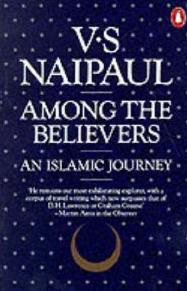
Book Review [27] : Among the believers - An Islamic journey

2001 Nobel Laureate V. S. Naipaul is a master of English prose. His travelogues are awesome piece of English literature. They give a glimpse of daily life of the people as well the history of the events leading to current situation. His 'India: A million mutinies now' is socio-economico-political survey of Nehruvian India.  I read this book almost 18 months back. In last week i read his another  masterpiece but this time its a survey of the condition of Islam among the converted people of Pakistan, Iran, Malaysia and Indonesia. Among the believers: An Islamic journey is a thought provoking book as it was written in 1979-81 but it seems that its written in the current era. Naipaul starts his journey in Iran in 1979 (just after the revolution) and travels across Pakistan, Malaysia and Indonesia in a span of few months. His perceptions and experiences of these societies and the inherent struggle between the culture and religion is worth experiencing.
Islam was founded by Prophet Muhammad and so it has all the ingredients of Arabic culture. It was a phenomenal revolution in the desert life and for the people with no sense pf civilization. Prophet gave them a way out from the eternal darkness. He brought the idea of unity without any caste, money, language or region based distinction. It is an absolute concept in its pure form. The problem started  after the death of Prophet in 632 AD. Islam had to face its first great rival in the civilization of great Sassanian civilization. Islam overpowered that easily but in doing that it got a different version of its self. It is Shiite form of Islam that believes in the Shiite Imams. Almost all the Persians were converted to Islam (either willingly or by coercion).  But they were successful in giving Islam a great civilization in arts, music, science etc. Arabia gave religion while Persia gave Islam its true glory. Iran (aka Persia) even today has the same language that they used to speak when Alexander the great decimated them although they had to change the script because of Arab imperial master. But in all the last 1360 years Iran never accepted the Arab imperialism. 

Lets talk about Pakistan. Pakistan was a home to world's first great urban civilization 5000 years back. It was home to the great king Porus who was able to hold against the mighty Greeks. It was land where great Kushanas ruled, where great Buddhists monasteries and caves flourished. The ancient land of Hindus, Buddhists and Zoroastrians does not have any monument of that era and even if it has then its in great danger of extinction. The hordes of Mohammed Bin Qasim who decimated the power of Sindh is celebrated in that land. Pakistan has even named its missiles Ghori and Ghazni, the two notorious invaders who invaded Pakistan and destroyed and killed the people of Pakistan before then could get a foot hold into India. I can not understand how a country can glorify its invaders. This can only happen in subcontinent.   

People with no sense of history can not develop a civilization worth cherishing. Pakistan is suffering from that disease and if it really wants to cure itself then it has to learn from Persia. Islamization of a country does not mean destroying its old culture, art, monuments, music etc. But unfortunately its been happening in almost all the converted countries. Malaysia and Pakistan are prime examples. 

Every civilization is built on the ashes of others and this cycle is law of time. Be it Greek, Roman, Indian, Persian or Spanish but other ways are also possible. Civilizations can also co-exist and if this experiment was never done before then its worth doing now. The "Victory" of Islam should never mean the "defeat" of other religions. Amen.

Highly Recommended (9/10)

Saturday, March 20, 2010

Indian Premier League: Part 3

Indian Premier League returns with a bang in India after a hiatus of 2 years.
It started with almost the same results. KKR dumbfounded all by winning first two matches and then losing miserably in last two matches. If i were SRK i would have removed Ganguly from the team after witnessing his disastrous performances in last few matches. Anyways KKR is gone case, a team can not win if its captain does not lead from the front. As far as other teams are concerned Deccan and Bangalore are looking awesome, Chennai and Mumbai are not too far behind. Delhi has enough material to knock out these four and i have no expectations from Rajasthan, Kolkata and Punjab. For Kolkata i can only say Kol never comes ;).

So far Kallis has been the man of the tournament and Gilchrist, Sachin, Jayasurya and Hayden are not far behind. I am betting for Mumbai Indians as always (atleast for the last 2 seasons). Deccan is my second favourite while my home town Bangalore is close third. Sachin has to prove that he could had been an excellent captain and he can prove that by winning this year IPL.

On a second note my friend Aviral met me today as he is in Bangalore for two days before going back to Indian School of Business to finish his ast 2 weeks. My other friend Saugata finished his inning with BT and going to start another inning in couple of days. All the best Saugata. I will miss your company atleast in BT.

Wednesday, March 10, 2010

Women reservation: my views

Dramatic scenes were produced by the honourable members of the upper house of Indian polity. The chairman had to ask 50 odd Marshall's to forcefully escort the belligerent "socialist" MPs from the Rajya Sabha. Some days back i saw the same scene (in Rome series) in which Octavian Ceasar asked his soldiers to forcefully pass few bills in Roman senate. The world has not moved a bit in these 2000 years. What these MPs did was shameful but what Marshalls were asked to do was more shameful. Unfortunately there were not many options for Mr. Chairman after having witnessed the brutal attack on 8th March 2010. Well, in these attacks and Marshall we are missing the whole point of reservation.
I totally agree with Yadavs when they say that this bill will deprive Muslims some say in our polity. Right now Muslim MPs are tiny tiny minority in MPs and by reserving 33% seats the Muslim men's chances of electing into assemblies will be reduced by 33%. Thats very true we do not have enough literacy among Muslim women and i strongly feel that Muslim women should be given some reservation within this quota (give them 6% reservation out of 33%, roughly in proportion to their share in population). This will help them a lot and will also help Muslim society in coming out from the humble state and will play a major role in implementing a uniform civil code in this country. But our constitution is vehemently against any reservation on the basis of religion so there goes my point as well as theirs.

Indian governments (past and present) have not done any effort to do an unambiguous and comprehensive socio-economic analysis of all the sections of Indian society. All the existing reports (Mandal, etc ) give conflicting data about % proportion of various sections of our society. Unless that is done,no one can justify reservation be it for SCs/STs/OBCs or for women. Still i am happy that in fiercely patriarchal Indian society, Indian women now can get some thing, can make laws and can rule the country and can help in reducing or eliminating the female infanticide incidents (although Yadavs will wage their final battle in the lower house). The battle in Lok Sabha will be the mother of all battles.

Sunday, March 07, 2010

Freedom of Expression and Freedom of Religion

After a long time, i am writing on politics. In a country of extremes and contradictions, faith and disparity, terrorism and Naxalism, its difficult for flesh and blood to remain impartial. Its a dangerous burden to be a citizen of the Republic of India. Sometimes i think its better to be citizen of Bhutan or Maldives as you wont be a prisoner of history, religion and "secularism". Recently Indian Media made a lot hue and cry about the plight of M. F. Hussain and his reluctantly acceptance of Qatar's citizenship.

Indian constitution provides two very important rights to Indian citizens. Right to freedom of expression and Right to freedom of religion. It has never said (as far as i know) which one is more powerful. If we talk about progressiveness of India we should always back right to freedom of expression against any other right or law. We have won our freedom because of this right and should always keep in mind that religion played its role in the division of the subcontinent. But we dont live in utopian society. Indians are religious as well iconic par excellence and no one has a right to offend the sensitivities of Indians on the ground of freedom of expression. I still do not know what one can get by depicting all those old Gods/Goddesses in nude/seminude or provocative posture. It does not make us any modern and still if this is the metric of modernness then we had already passed this state when Chandellas of Central India built those monuments of Khajuraho or when Vatsyayan wrote the eternal Kamasutra. Fida Hussain has not added any new bit to the existing Indian art by those paintings (Here i am talking about those select controversial paintings). He has only made the rift in the Indian society more wider. Still its a shame that we can not guarantee his safety in India. The country that has given shelter and life to Jews, Parsis, etc has failed to give room to one of her greatest icons. Its a real shame.