
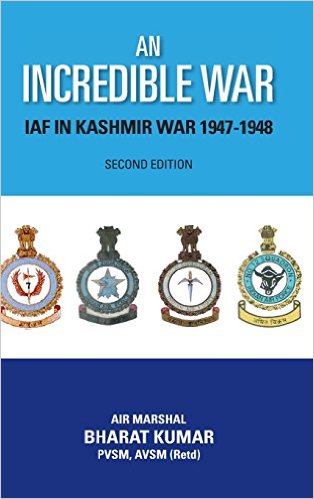
An Incredible War - IAF in Kashmir War 1947-1948 by Air Marshal (retd) Bharat Kumar is a brilliantly researched book on the role of Indian Air Force in Kashmir war.
Jammu and Kashmir in October 1947
Maharaja of Kashmir
signed standstill agreement with Pakistan on 12th August 1947 but no
such agreement with India. Pakistan started pressurizing Kashmir by withholding
supplies of Kerosene, gasoline, food, edible oils, salt etc.
Colonel Akbar Khan
(later Major General) was put in charge of the operation of the invasion of
Kashmir by tribesmen. The full scale invasion was launched along the Domel
road. The Domel road links to Baramula and then to Srinagar.
On 24th October, Radio Pakistan announced the formation of the
provisional government of Kashmir with Sardar Mohammed Ibrahim as its head. The
government was recognized by Pakistan. The broadcast also alleged that Maharaja
had fled from Kashmir. Operation Gulmarg
was the name given to the main invasion that was launched on 22nd Oct
1947. The invading raiders consisted of tribesmen, members of Muslim League,
ex-Indian National Army personnel, ex-Servicemen led by Pakistani Army
personnel.
The main column of
raiders drove down the Domel road and headed for Srinagar. These columns were
held up at Uri by the brave action of the state forces under the command of Brigadier Rajinder Singh who died
defending his state but the progress of raiders were slowed down. Rajinder
Singh left with about 100 men and reached Uri on 22nd Oct. First
engagement took place on 23rd Oct, enemy suffered heavy casualties
but Rajinder Singh lost one of his platoons. He got the Uri Bridge blown up,
this slowed the raiders down. He delayed the enemy at Mahura on Oct 25th
and gave a determined fight at Rampur Buniyar till 0100 hrs on 27th Oct.
He was hit in arm and leg but he continued to rally his men, unfortunately he
was captured by raiders never to be seen again. He was the first Indian to be
awarded MVC. By Oct 24 the raiders had over run Uri and reached Baramula.
Baramula was pillaged, raped etc on 26th Oct but this gave crucial
time to Maharaja and Indian forces.
The information of the
launch of the Raider's offensive was conveyed by the C-in-C of Pakistan Army Major
General Douglas Gracey to General Sir Rob Lockhart the C-in-C of Indian Army on
24th Oct evening. General
Lockhart did not give this update to Nehru but to Mountbatten. Nehru came to
know about this after 6 crucial hours from Mountbatten. Maharaja appealed for
Indian assistance on 24th Oct 11 PM. Defence Cabinet Committee (DCC) met on 25th
Oct at 10 AM, Mountbatten view that since Maharaja had not acceded so it won’t
be justified to send Indian forces to Kashmir prevailed. Though Indian Army was
asked to prepare for the assistance/operation on an urgent basis and Shri V P
Menon was sent to Kashmir to assess the situation and discuss the question of
accession with Maharaja. Menon was
accompanied by Colonel Sam Manekshaw (later Field Marshal) and Wing Commander H
C Dewan to Kashmir. Maharaja signed the
Instrument of Accession on 26th Oct. There were only two
all weather air strips – Jammu and Srinagar but both were for Maharaja’s
private light aircraft, not fit for heavy aircraft. Srinagar airfield was like Jammu and kutcha
grass strip and was usable only in summers and definitely not after Nov. Gilgit
also had a short airstrip.
Role of British Officers
Junagadh Nawab
announced on 15th August 1947 the accession of his state to Pakistan.
The accession was accepted after almost a month by Pakistan on 13th
Sept 1947. When the need of invasion of Junagadh arrived the three Service
chiefs of Indian Army wrote a joint letter to the cabinet that Indian Armed
Forces are not in a position to undertake a serious campaign (the same armed
forces had come out with flying colors during WW II) and that British soldiers
would not take part in any operation which would involve a clash with another
Dominion. This was nothing sort of a mutiny and these officers should have been
sacked. The three chiefs got a tongue lashing from the Governor General.
Mountbatten managed to obtain the chairman ship of the Defence Committee of the
Cabinet (DCC) normally PM should the chairman. By virtue of this office Mountbatten
was almost always able to influence the decision of this committee.
DCC consisted of
Governor General, PM, Deputy PM, Defence Minister and any other Minister the PM
desired. This was different in Pakistan, there Political leadership enjoyed
strict control over armed forces.
The DCC met on 26th
Oct. Mountbatten and three service chiefs opposed dispatch of troops to Kashmir
as in their opinion the airlift involved great risks and danger. These were
countered by Indians and it was decided that the risks were worth taking. It was agreed to airlift troops to Srinagar
the next day i.e. on 27th Oct.
Sardar Patel at once
requisitioned all available civil aircraft by means of a radio broadcast. 1 Sikh Battalion commanded by Lt Colonel Dewan Ranjit Rai was the
first battalion to fly to Kashmir on 27th Oct morning. RIAF aircraft
Dakota played a crucial role. 1 Sikh was to land only if the Srinagar airport
was not occupied by the raiders. The first plane landed at Srinagar airport by
1000 hrs on 27th Oct. 27th Oct was Eid. PM Nehru
instructed Brigadier Hiralal Atal to send code word from Kashmir after reaching
there. The ‘Lion’ code meant situation under control and more troops needed
while ‘Jackal’ means it would be
futile to send more troops. Brigadier sent the code word ‘Lion’ at 1000 hrs on 27th Oct. The airfield was still
not captured by the raiders though the aircraft who took wider circle got hit
by the bullets though nothing serious happened.
Only 300 men were sent
on 27th Oct while raiders were more than 5000. During the first
three days about 900 men with arms and ammunition were lifted to Srinagar and
by 5th day the entire 161 Brigade was airlifted.
Leaving one company
for airfield protection, Ranjit Rai went forward to Baramula with two
companies. He was engaged by the raiders on the outskirts of Baramula. He
engaged the raiders for better part of 28th Oct, in face of
overwhelming numbers of raiders he withdrew from Baramula to Pattan, half-way
between Baramula and Srinagar. During this withdrawal Rai achieved martyrdom.
The remaining 1 Sikh were able to hold the raiders.
Battle of Badgam
This battle was caused
by withdrawal of Indian forces from Baramula to Pattan on 28/29th Oct, the enemy
thought India was retreating so they advanced. On 3rd Nov 1947 Major
Somnath Sharma of 4 Kumaon held the invaders till his ammunition allowed him
and sacrificed his life defending the Srinagar Airfield. His right arm was
heavily plastered and yet he fought. He had one company (less than 150 men) and
he was attacked by about 700 men. His company was surrounded by 1435 Hrs on 3rd
Nov. His men fought to the last round. He was posthumously awarded PVC. The
RIAF machine-gunned the raiders and caused heavy causalities few hours later.
About 200 raiders died in RIAF action. The raiders withdrew. By 3rd
Nov the immediate threat to Srinagar airfield had been averted.
Battle of Shalateng
The raiders were on
Baramula – Pattan road. The offensive on raider’s position was launched on 7th
Nov. It was a combined attack of RIAF and Army. About 300 raiders were killed
in this battle. Baramula was liberated on 8th Nov. The remaining
residents of Baramula welcomed Indian troops.
PM Nehru flew to
Srinagar on 9th Nov. Brigadier L P Sen played a commendable role in
Kashmir operations. Uri was liberated on 12th Nov. He wanted to
pursue the raiders to Domel but higher authorities asked him to relieve
besieged Poonch instead. With the capture of Uri, the liberation of the valley
was complete. The raiders would never threaten the valley again. But we lost
the opportunity to capture Muzaffarabad and this is costing us dearly.The raiders before
joining the battle used to pray “Kali pagri ke kafiron aur khuda ka bachchon
se bachao”. Kali pagri means black turbaned Sikh regiment troops while
Khuda ka bachcha means RIAF.
Fall of Gilgit and siege of
Skardu
Gilgit province was about
38,000 sq km large and is highly mountainous. The main towns are Gilgit, Skardu
and Bunj. These towns along with Dras
and Kargil in Baltistan are important points of communication systems in the
area. Kargil was connected to Srinagar via Dras and Zoji La. Gilgit also
commanded one of the two main caravan routes from Srinagar via Burzil Pass and
Minkata Pass to Kashgar. An equally
important route led eastwards along the Indus to Skardu and Kargil and onwards
to Leh. Gilgit had that time a makeshift airstrip. There were no roads leading
to Gilgit only tracks and passes.
Gilgit area was
occupied by Sikhs in 1842 and Maharaja Gulab Singh in 1846. In 1852 there was a
revolt and Dogra rule was thrown out. In 1860 Maharaja regained possession but
the area never remained under effective rule of Srinagar. Gilgit came under
British rule in 1889 and it took over the military and political administration
of the tribal region.
In 1935 the entire Gilgit region was leased to British for 60 years. The lease lapsed in June 1947 because of British plan for departure. Maharajah appointed Brigadier Ghansara Singh as Governor of Gilgit on 30th June 1947. He flew to Gilgit on 30th June along with Major General H L Scott, Chief of J & K state forces. The local population welcomed the return of Maharaja Administration. Major William Brown was one senior British officer in Gilgit. The subordinate chiefs were Mir of Hunza, Mir of Nagar, Raja of Punial and chiefs of Kosh Ghizar. The Mirs of Hunza and Nagar were hostile. The Gilgit scouts mainly came from Hunza and Nagar regions and their commander was relative of both the Mirs. Maharaja failed to act against the hostile elements and Major Brown staged a coup with the aid of Agency staff and Gilgit scouts and imprisoned Brigadier Ghansara Singh on 31st Oct 1947. At the time of this treachery, Gilgit was garrisoned by 6 J & K Infantry, less about 2 companies with headquarters at Bunji, about 54 km from Gilgit. The battalion comprised of Sikhs and Muslims in equal proportion. Captain Matheson, on instructions from Major Brown stormed and captured Bunji, massacred the Sikh troops. Major Brown hoisted the Pakistani flag on 3rd Nov 1947. The region was taken over by Sardar Mohammed Khan. Major Brown returned to England in 1948 and he was awarded MBE by British government.
In 1935 the entire Gilgit region was leased to British for 60 years. The lease lapsed in June 1947 because of British plan for departure. Maharajah appointed Brigadier Ghansara Singh as Governor of Gilgit on 30th June 1947. He flew to Gilgit on 30th June along with Major General H L Scott, Chief of J & K state forces. The local population welcomed the return of Maharaja Administration. Major William Brown was one senior British officer in Gilgit. The subordinate chiefs were Mir of Hunza, Mir of Nagar, Raja of Punial and chiefs of Kosh Ghizar. The Mirs of Hunza and Nagar were hostile. The Gilgit scouts mainly came from Hunza and Nagar regions and their commander was relative of both the Mirs. Maharaja failed to act against the hostile elements and Major Brown staged a coup with the aid of Agency staff and Gilgit scouts and imprisoned Brigadier Ghansara Singh on 31st Oct 1947. At the time of this treachery, Gilgit was garrisoned by 6 J & K Infantry, less about 2 companies with headquarters at Bunji, about 54 km from Gilgit. The battalion comprised of Sikhs and Muslims in equal proportion. Captain Matheson, on instructions from Major Brown stormed and captured Bunji, massacred the Sikh troops. Major Brown hoisted the Pakistani flag on 3rd Nov 1947. The region was taken over by Sardar Mohammed Khan. Major Brown returned to England in 1948 and he was awarded MBE by British government.
The news of the
treachery at Gilgit reached Srinagar almost a week later. There were not enough
forces to take any action against the treachery. On 21st November
1947, Lt Colonel Sher Jung Thapa was asked to move to Skardu from Leh and
defend Skardu with the remaining elements of 6 J&K Infantry. He reached
Skardu on 3rd Dec. He had just 40 Sikhs and 31 Muslim troops to
defend Skardu against more than 600 hostiles. He fortified his defenses on
Skardu fort. The strength of Thapa troops increased to 285 men by 15th
Feb because of reinforcements. The situation of Thapa was desperate by April 9,
1948 and he requested Srinagar for an immediate help. General Thimayya ordered
Thapa to withdraw from Skardu and join another column near Marol on 16th
May. India had already lost Kargil and Dras by then so any help to Skardu was
almost impossible. Thapa said its
impossible to withdraw as he had women and children along with combatants. Lt General Thimayya asked RIAF to strike the
invaders at Skardu but it was rejected. He raised the matter with Defense Minister.
Defence Minister said it was not practical.
The RIAF went into
action starting on 19th June 1948, the raiders suffered heavy causalities.
The RIAF dropped supplies but about 50% fell into enemy hands.
Under desperate
situation and as ordered by General Thimayya, Thapa surrendered the fort on 15
August 1948 what followed was a massacre. All the Sikhs were shot dead. Thapa
became a PoW and survived because he knew C-in-C Gracey of Pakistan Amry. The
siege lasted more than 6 months. Thapa was awarded MVC. The Pakistani
commanders reported back to HQ that “All
Sikhs shot, all women raped”. The entire Hindu population of Skardu was
reduced to ashes by Pakistani forces. We lost Skardu because Indian Army and
RIAF did not fully appreciate its importance and failed to allocate adequate
resources.
RIAF continued bombing
Skardu and Gilgit. In Oct 1948 Skardu was heavily bombed by RIAF. RIAF also
flew offensive operations in Chilas.
Ladakh
There are three
important valleys in this region - Indus, Zanskar and Nubra. Zanskar is more
remote and its in south while Nubra is in north. Akshai Chin (now in Chinese hands), Baltistan,
Skardu, Kargil are also parts of Ladakh plateau. Zoji La pass connects Ladakh
plateau to the Kashmir valley. Srinagar can be reached from Leh through Dras
via Zoji La. Leh was summer capital while Skardu was the winter capital of
Ladakh.
In 1947, J & K
State forces had only 8 Infantry battalions i.e. about 4000 men. One Battalion
less two companies was deployed at Bunji, two platoons at Kargil, One company
less a platoon was at Skardu and Leh had just one company less a platoon. After
the departure of Thapa to Skardu only 33 men remained at Leh.
Operation Sledge was the code name for the capture of Leh, was
planned by Pakistan Army and launched from Gilgit in mid Feb 1948. On 16 Feb,
1948 Brigadier L P Sen sent 1 platoon of 2 Dogras under Major Prithi Chand followed
by two platoons so the State forces for the defence of Leh and to train the
locals for the defence of Leh. Major Chand and his platoon reached Leh on 8
March 1948. He was accompanied by an energetic Ladakhi engineer Sonam Narboo.
Narboo was assigned the task of making a makeshift airstrip at Leh. He made it
ready by 6 April 1948.
Pakistani raiders made
a 4 pronged attack simultaneously at Gund, Pindras, Dras and Kargil on 10th
May 1948. Only Kargil attack was successful. With the fall of Kargil, situation
in Leh became desperate. The raiders were at the gates of Leh on 23rd
May 1948. The airfield was located at a height of 3256 m and RIAF had no
experience of flying at that height, it was then the highest airfield in the
world.
Air Commodore Mehar Singh created history on 24th May
1948 when he landed his ancient Dakota at Leh negotiating the mountains
towering more than 5000 m. His passenger was Major General Thimayya. It was an
unprecedented feat. Dakota and other RIAF aircrafts had no Oxygen support. On 1st
June Mehar Singh led the RIAF 6 aircrafts to fly an entire company of one
Gurkha Battalion to Leh. The local people were thrilled and they welcomed
Indian forces with all the hospitality as their disposal. RIAF saved Leh at the
most critical time of its history. More reinforcement s came through Manali
route.
Dras fell to raiders
in early June 1948. There was just one company of 1 Patiala between Dras and
Srinagar to ensure Zoji La remains open. Leh was getting isolated. The raiders
came close to Nimu only about 30 km from Leh on 12th July, the
situation of Leh again became desperate by 13th July. But the
defenders continued their valiant effort. Reinforcements arrived to Leh on 15th
August 1948.
Zoji La Operations
The raiders controlled
all approaches to Zoji La from the Kargil side by 7 July. Indian Army made many
attacks on the raider positions in Sept but all attempts failed to dislodge the
raiders. RIAF also attacked bunkers with bombs. Kargil and Zoji La were in the
hands of the raiders at the end of Sept 1948. These two locations are keys to
the defence of Ladakh. It was necessary to clear them before the onset of
winter.
Indian Army planned an
all out offensive to capture Zoji La. Major General Thimayya personally flew an
air reconnaissance mission over Zoji La on 15th Oct 1948 piloted by
Mehar Singh. There was a complete secrecy in bringing up the tanks. The tanks
were brought from Jammu in complete secrecy. The attack finally went through on
1 Nov 1948. The attack was total and enemy was shocked. Zoji La pass was
cleared within 12 hours. Indian offensive continued and RIAF bombed the enemy
positions. Dras was captured on 13th Nov. Kargil was captured on 23rd
Nov 1948. The onset of winter made any other operation impossible. Mehar Singh
aka Mehar Baba was awarded MVC. He died in an air crash in 1952. For raiders he
was either a magician or a prophet.
Western Operations
By 15th
Oct, the raiders had penetrated into Poonch and Mirpur. The focus of India was
on saving valley so initially this sector did not receive much attention. The
state forces had been surrounded by enemies at Mirpur, Kotli, Poonch, Jhangar,
Naushara, Rajouri etc. These forces were sheltering thousands of lives almost
exclusively all of them were non-Muslims. J & K PM M C Mahajan pleaded with
Nehru on 3rd Nov to save the besieged forces. RIAF carried out the
recon of Kotli, Bagh, Muzaffarabad and Sangram areas on 3rd Nov.
RIAF attacked enemy positions in Kotli areas. Rajouri fell in Nov and about
30,000 persons were massacred and abducted and 1500 refugees at Chingas were
killed.
Rawalkot was evacuated
by state forces and joined Poonch garrison along with 600 refugees. Naushara
and Jhangar were relieved by Nov 19. Kotli garrison was relieved on 27th
Nov and 9000 refugees were saved. Unfortunately the garrison at Mirpur could
not be relieved due to paucity of troops but it managed to fight out its way to
Jhangar bringing about 10,000 refugees.
C-in-C of Indian Army
tried to persuade Indian PM Nehru to evacuate Poonch but Nehru declined. It was an herculean task to maintain the
besieged garrison at Poonch. There were about 40,000 refugees in the town. On
29th March 1948, Poonch was completely surrounded.
The raiders were
actively engaged in clearing out all Hindus from the areas between Akhnur and
Bhimbar. Hindus were massacred in large numbers and villages were burnt. On 2nd
Dec, about 45,000 refugees crossed the Chenab river bridge and crossed to Jammu
from Akhnur. Indian army captured Chhamb on 10th Dec 1947 but RIAF
lost two aircrafts in this effort. Jhangar was lost to raiders on 24th
Dec. It was a vital link between Mirpur and Kotli and not too far from
Naushara. About 6000 raiders captured it. The 2500 strong raiders attacked
Naushara on 24th Dec night. The attack was successfully repulsed
with heavy casualties on both sides.
Battle of Naushara
The enemy gathered in
large numbers about 15000 strong and stormed Naushara on 6th Feb
1948. Brigadier Usman was Indian commander in this sector. India achieved a
decisive victory here and more than 2000 enemy troops were killed in the
battle. Naushara was saved.
Capture of Rajouri
There were wide scale
reports of barbaric actions taken on non-Muslims by the raiders in Rajouri
town. The advance to Rajouri commenced on 8th April 1948. Indians
captured the town on 12th April just in time to save the lives of
1500 refugees, mostly women. Of these, 300 to 500 had been lined up to be shot.
The non-Muslims were massacred in large numbers and their decaying bodies were
left in open pits. RIAF played a key role.
Advance to Tithwal
Tithwal lies to the
north of Muzaffarabad. 1 Sikh captured Kupwara on 12th Feb. The
operation to capture Tithwal was launched on 18th May and it was
captured on 23rd May with enemy withdrawing across the river
Kishanganga. The Kishanganga bridge was attacked on 24th April with
the help of RIAF. It was a daring attack. Indians did not press the advantage
here otherwise we could have threatened Muzaffarabad itself. Pakistan
counterattacked and recaptured some vital ground. UNCIP visited India in July and
on its appeal Indian Spring Offensive was halted. Pakistan exploited this
situation and captured some grounds along Kishanganga river. In August India
tried to damage Kishanganga bridge but failed.
Defence committee of
the Cabinet in its meeting of 30th Sept ordered for an appreciation
to be prepared for the capture of Muzaffarabad and an attack on Mirpur. The
appreciation was prepared by General Cariappa. The plan for invasion of
Muzaffarabad and Mirpur did not come as ceasefire came into effect on Jan 1949.
Relief of Poonch (Operation Punching)
Poonch had about
40,000 Hindu and Sikh refugees. It was attacked by raiders since Oct 1947. RIAF
attacked the positions of raiders from 3rd Nov 1947 onwards and
blunted their attacks. There were about 3000 troops at Poonch - 2000 from J
&K State forces and 1000 of Indian Army. The raiders encircled Poonch with
the obvious aim of reducing the garrison by starving them and by their
firepower.
Lt. Colonel Pritam
Singh built a 600 yards long airstrip close to the town in late Nov 1947. The
RIAF managed the garrison going through regular sorties. Mehar Singh landed
Harvard on this ultra small strip. RIAF continued the supply of provisions and
the garrison continued going against all odds. About 35,000 refugees were
evacuated by the Dakotas. 9th Gurkha Battalion was flown in from
Jammu to Poonch to reinforce the garrison in Feb 1948.
To reduce the pressure
on the air supply of food and to augment stocks, harvesting operations in the
fields in the neighboring enemy-held areas were carried out by the refugees at
Poonch. The refugees were escorted by the Indian troops.
The sorties of RIAF to
Poonch were halted after March 1948 in face of accurate firings by Pakistani
Army. The enemy noose
tightened by Sept 1948 and they brought up 25 pounder guns. In the three phase
operation Poonch was captured on 20th Nov 1948 after almost one year
siege.
Royal Indian Air Force played a stellar role in the defence of Jammu and Kashmir. Wing Commodore Mehar Singh achieved feats that only giants can achieve. It was the first war India fought and Indian Air Force did not let our country down.
Highly Recommended (9/10)


