Saturday, February 22, 2014

Book Review [87] : Liberation and Beyond

It is said that 'The Revolution always devours its first children', it was true in the case of French Revolution and it was equally true in the Liberation of Bangladesh and its aftermath. France lost all its heroes of Revolution in the bloody years of guillotine and Robespierre, and so was Bangladesh in the bloody months of post monsoon season of 1975.
'Liberation and Beyond' is a brilliantly written book by J. N. Dixit (1936-2005), an eminent Indian diplomat who had first hand information on Bangladesh affairs during those critical years of 1970s. J. N. Dixit was posted in Dacca as Deputy High Commissioner of India and before that posting he played a key role in liberation movement as well. Later he became Foreign Secretary and National Security Adviser of India.
This book provides details about the circumstances that led to the liberation war of Bangladesh, the role played by India in the movement, the help given by Soviet Union to India, the hurdles and pressure exerted by USA and China and the genocide perpetrated by likes of General Yahya Khan, General Niazi Khan and Zulfikar Ali Bhutto.
Bangladesh paid a very heavy price for its independence, millions of people died because of the atrocities of Pakistani army and Al Badars, millions of women were raped, intellectuals were systematically wiped out amidst the deep silence of UN and the proponents of Human Rights and Democracy. At one time USA sent its 7th fleet led by Aircraft Carried Enterprise on 13th Dec (3 days before the end of the war) to Bay of Bengal but USSR came to India's rescue and the threat was warded off. Bangladesh won its independence on 16th Dec 1971 and it appeared that day that it would only have glorious future and certainly it was until March 1974, the mishandling of the economy and politics by Mujibur Rahman led to deep discontent and the rise of Pro-Pakistani elements that eventually led to the extermination of the entire leadership of Awami League in later half of 1975 precipitating the degeneration of Bangladesh. Things have been improving since 1990s but the ride has been zig-zag so far.
Its a must read book for any Indian and the student of diplomacy can not afford to ignore it.
Highly Recommended (9/10)

Tuesday, February 18, 2014

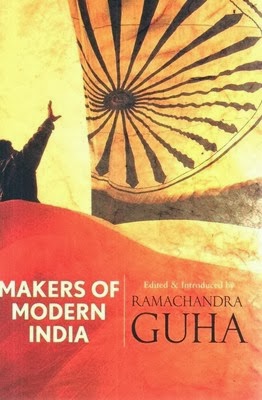
Book Review [86] : The Makers Of Modern India

Ramachandra Guha is a writer who knows how to write books that can sell. 'The Makers Of Modern India' is a very good book though this book is not "written" by him in a strictly technical sense. This book is perhaps better than "India After Gandhi". 
In 'The Makers Of Modern India', Guha talks about 19 great Indians who played a key role in nation building. Although he has missed some great names like Sardar Patel, Bhagat Singh, Subhas Chandra Bose, Maulana Abul Kalam Azad etc yet the truncated list is a worthy list. He writes a brief biography of these 19 Indians and then produces excerpts from their major speeches and works. These 19 Indians are (not in any order) - Raja Rammohan Roy, Dr. B. R. Ambedkar, C. Rajagopalachari, Mahatma Gandhi, Jawahar Lal Nehru, Lokmanya Tilak, Gopal Krishna Gokhale, Verrier Elwin, Sir Syed Ahmed Khan, Hamid Dalwai, Tarabai Shinde, M. S. Golwalkar, Jotirao Phule, Dr. Ram Manohar Lohia, Jayaprakash Narayan, Muhammad Ali Jinnah, E. V. Ramaswami, Kamaladevi Chattopadhyay and Rabindranath Tagore. 
I have not read before in detail about Jayaprakash Narayan, Rajaji, Verrier Elwin and Hamid Dalwai, so their writings and thoughts have been a revelation to me. These three Indians were much ahead of their times, JP was uncompromising democrat, advocate of decentralization and defender of human rights, Rajaji was perhaps the first advocate of free economy and electoral reforms, Verrier Elwin was defender of tribals against the encroachment of "modern civilization" and Hamid Dalwai was perhaps the first uncompromising secular leader after 1947. Well i knew JP and Rajaji before but this book introduced Kamaladevi, Tarabai, Hamid Dalwai and Verrier Elwin to me and for this i thank Guhaji.This book is a must read for everyone and i regret why i have not read this book before.
Highly Recommended (9/10)

Wednesday, January 22, 2014

Book Review [85] : The Idea Of India

'The Idea Of India' is a collection of 5 big essays on various dimensions of Indian union and Indians. Written by Sunil Khilnani, it basically talks about the development or degeneration of Indian politics, her cities, democracy and the evolution of Indian identity. Sunil Khilnani talks about Nehru's idea of India in glowing terms and blames later Congress leaders for the decline of Secularism and the faith in Indian identity mainly because of the rise of Caste and religion based politics. 
As such its a not a great book for a person who has Patrick French/India after Gandhi etc but still its a reasonably good read for a novice reader or a reader who is not aware of Indian history. This fades in comparison with both 'India:A Portrait' and 'India after Gandhi', the writer does not do much justice with the title of the book and does not objectively analyze the ideology of the right and of the left. The essay on "Cities" is really good but even it fails to connect with the well informed reader.
Recommended (6/10)

Monday, January 20, 2014

Book Review [84] : India Wins Freedom

'India Wins Freedom' is an autobiography of a great India Freedom Fighter and one of the builders of Modern India, 'Maulana Abul Kalam Azad (1888 - 1958)', put into words by Humayun Kabir. It was published in two phases one in 1958 (without 30 pages critical of Patel, Nehru and Gandhi) and the complete version in 1988. 
Maulana Azad was born in a family of great Islamic theologians in Mecca, his family moved to Calcutta (now Kolkata) in 1890. He was there at the founding session of Muslim League in 1906 and his career took a rapid start during the Khilafat movement. He championed the cause of Urdu Journalism and continuously wrote nationalist articles despite of seizure of his press by the British. He became the youngest person to become the President of Congress although in a special session (in 1923). He was the longest serving (1940-46) President of Congress before the advent of Indira Gandhi. He lost his wife when he was in Jail (1942-45) and Britishers did not allow him to even pay the last visit to his dying wife; such was the sacrifice he made.
He accuses Sardar Patel of Communalism and calls him the founder of the partition of India; he blames Gandhi as well as Nehru for the partition albeit in a moderate manner but the way he puts venom on Patel, its tough to digest as Patel was not alive at the time of publication of this book to give his own account, similar was the case with Gandhi and to a certain extent Pt. Nehru. He blames Congress for the partition and calls the actions of Jinnah a bit of exploitation of the blunder made by Congress in vacillating around Cabinet Mission proposal. At many places he says that Muslims has played a heavy price of the partition but he does not say anything about the Hindus/Sikhs of the Pakistan (and Bangladesh). He becomes completely partisan of the interests of the Muslims during the riots and does not say a thing about the interests of the non-Muslims in Pakistan. 
A nice read, it gives another perspective of the freedom struggle and the tense and bloody days of 1940s.
Highly Recommended (8/10)

Thursday, January 09, 2014

Book Review [83] : The Widening Divide

Rafiq Zakaria is a widely read Muslim Scholar, known for his books on the relations of Hindu-Muslim communities. I got a chance to read his book "The Widening Divide" - a book on the complexities of Hindu-Muslim relations. I was attracted by the title of this book and i tried to read the book with an open mind. The author says that he has written this book primarily for Hindus to dispel some myths and falsifications about Indian Muslims spread by the Hindutva Brigade. I have to confess here that i am a non-practicing Hindu but i do have firm belief in my religion; on other hand i do hold other religions in respect.
He covers various complex issues mainly - the behavior of Muslim Invaders and Kings on their Hindu subjects, the Kashmir question, the riots, the Ayodhya issue, the partition,  reforms-economic-social conditions of Muslims and the charge of Hindutva Brigade. He is pretty neutral and appears very objective overall but at places the words betray his cause. He conveniently forgets the Mappila riots of Kerala during the Khilafat movement, the plight of Hindus in Pakistan and Bangladesh, Iltumish and Aibak were shown in good light ignoring the temples looted and desecrated by these and other rulers of Delhi Sultanate and of Mughal Empire. The gory destruction of Hampi is conveniently ignored by him. No one can deny the role played by various Sufi saints in the conversion of Hindus into the fold of Islam but no one should also deny the role played by the power of sword and Jizyah tax. North Indian plains do not have any ancient temple or monument; the oldest monument in the north Indian plains would be Qutub Minar if i am not wrong, i will be more than happy to be proved wrong here.
Its very easy to abuse Hindutva movement or call them Fascists but the most important question that should be asked is why this movement enjoy so much support among the masses. There has to be some element of truth in the ideology of this movement. Unless the questions raised by his ideology are not answered and are not perceived to be answered this movement would continue to gain momentum in the dangerously fertile land of India. Perhaps Zakaria sahib and perhaps we all should try to find these answers, it is never too late unless u call it late.
Recommended (7/10)