Showing posts with label Book Review. Show all posts

Wednesday, March 04, 2026

Book Review [174] : Surrounded By Idiots

A beautiful 'Book Fair' was organised in this year's Exhibition (also called Numaish) in Aligarh in Feb. I bought about a dozen books in this fair. 'Surrounded by Idiots' by Thomas Erikson came as a highly recommended book by the shopkeeper. 


This book is basically a study on the personality traits/types and how to converse with them, how to manage them and how to deal with them. As per the book there are 4 types of persons:

    1. Red (Dominant, Aggresive, Egoist)

    2. Yellow (Extrovert, Talkative, Egotist)

    3. Green (Submissive, Quiet, Worker, Introvert)

    4. Blue (Perfectionist, Analytical worker, Introvert)

I don't know whether its correct to compartmentalise people or not but in a way this books gives certain ideas about behavioural aspects of people.

The title of the book is a kind of misnomer.

Wish you all a very happy Holi. May this festival bring lot of happiness and colour in your lives. 


Sunday, March 23, 2025

Book Review [172] : The Power Of Now

A book that's more than 5 million copies has been sold since its first publication deserves to be read. 'The Power of Now' by Eckhart Tolle is one such book. Through various random links and twitter accounts of prominent intellectuals this book got my attention.

To an eastern mind this book is an average read and "nothing" to offer except to observe the moment that is now without thinking about the past and worrying about the future. Though it looks simple but it's a very powerful concept. Most of the times we live in our past and get ourselves busy in past glory, animosities and lost chances and remaining time gets occupied in future planning. We (most of us) disrespect our present. This book underscores our present.

Over thinking is a major issue. We always think and think and because of this the mental noise always clouds our true inner being. This book also tells how to get rid of this 'absurdity'.

This book is a slim book, about 191 pages. First half is really good and introduces/emphasizes concepts that are really good while second half is pretty boring and looks superfluous.

I will still recommend this book as it has Some Thing to offer depending on how much exposure one has towards spirituality/meditation.

Recommended (8/10)

Tuesday, January 14, 2025

Book Review [171] : The Power Of Your Subconscious Mind

'The Power Of Your Subconscious Mind' by Dr. Joseph Murphy is the first book i read this year. It has a very high rating and more than a million copies have been been sold since its inception. It was first published in 1963 and since then it has been translated in more than 30 languages.

I found this book very effective. It talks about how to bring positivity in life and how to achieve calmness/greatness. Some may call it pseudo science but it is what it is. Similar concepts we learn when we meditate or do guided meditation or indulge in Yog Nidra. Break the connections between conscious mind and the outer world and let your subconscious mind take control.


Its an old wisdom that says 'Think good and good follows. Think evil and evil follows. You are what you think all day'. It was correct then, it is correct now. 

Nothing can disturb you but your own thoughts. The suggestions, statements or threats of others have no power. What the other person says or does can not really annoy or irritate you except when you permit him to disturb you. You should not let some one else to disturb your peace of mind.
 
Do the thing you are afraid to do, and the death of fear is certain.

Spread light not darkness. 
Spread positivity not negativity.
Spread goodness not evil.
Stay positive, stay good and always make your mind free from all doubts and negative energy. Always start the day on a good note and end the day with a good note. You are the captain of your soul, master of your fate. World is yours dear friend.


Highly Recommended (10/10).

Monday, November 25, 2024

Book Review [170] : Fooled By Randomness

I bought 'Fooled By Randomness' almost 8 years back from a shop in Bengaluru and it stayed in my bookshelf for those many years. This month i got a chance to read this book and i found it intriguing, confusing and radically important book in our chaotic world.


I found at times this book pretty boring and sometimes i felt that instead of giving 250 odd pages to it, the ideas could have been covered in less than 100 pages. The focal point of this book is about the role played by sheer random dice of fortune in our daily lives that we sometimes credit our skills and hard work. Nassim gives a large number of examples including the seminal example of infinite number of monkeys on infinite keyboards; there is a probability that some monkey will reproduce Iliad, Odyssey or even 'Fooled by randomness'. 
 
Another concept though very common is about 'Hindsight bias'. A mistake is not something to be determined after the fact, but in the light of the information until that point. Another linked concept is 'Survivorship bias' - We do not take account for losers in our sample size. The survivors path decide everything for make gurus though they might have been lucking in surviving.
 
In nutshell its a good book and should be read as it triggers good ideas in our brain. Sometimes or may be always its better to be a fooled by randomness. Sometimes it breaks the stalemate. In the end it is always a better practice to be a stoic and do not let randomness compromise your dignity.
 
Highly Recommended. 

Sunday, October 20, 2024

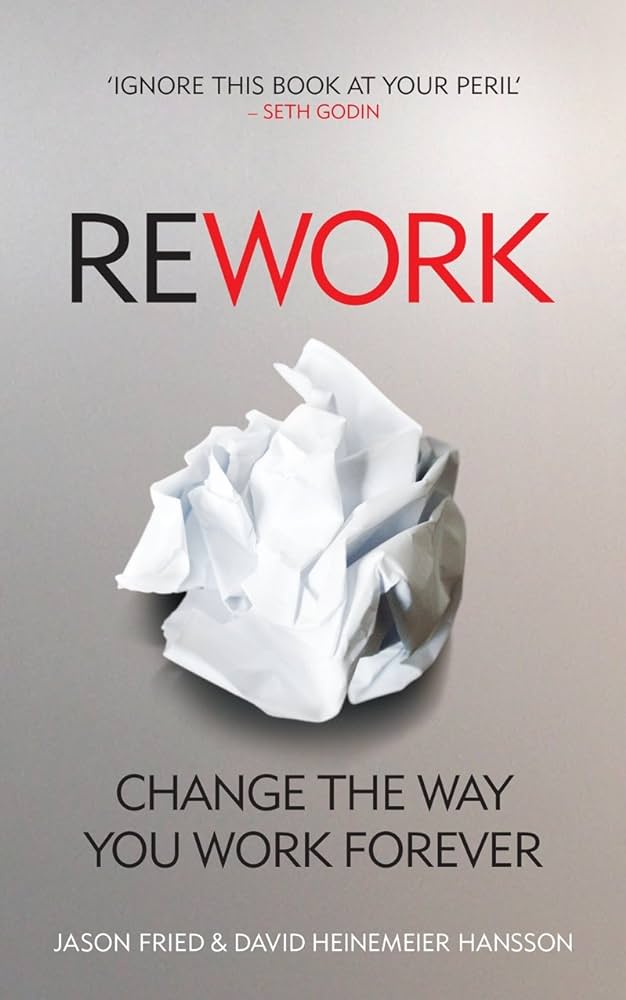
Book Review [169] : Rework

'Rework' is a beautifully written work by Jason Fried and David Hansson. It's such a lovely read that you can finish it within couple of days if not in a day.

There are pretty good few lessons from this book.

Workaholics are not Heroes - It sounds pretty logical today, but I was kind of one 10 years back and I consider to be that even today. In my first job way back in 2005 I used to consider those people who leave office by 0630 PM as losers and mediocre and whose who burned midnight oil as actual geeks. This is pure poison and basically it kills good office culture. It should be avoided and this book underscores this point really well.

We should take responsibility of bad news and failures. We should not let the rumour mongers decide our response to failure.

Don't be a fake. No body likes plastic flower. Be natural and be spontaneous.

We need to know how far we can push some one. This is the thing I read few decades back from some Australian Cricket player when he talked about Steve Waugh leadership. He wrote that if Steve asks us to hit our head to the wall, we will do it without thinking twice. This is one of the most fundamental traits of a good leadership.

Perfect time never comes so don't defer your decisions waiting for that moment. Every decision made is a progress.

The single most important thing that is killing our productivity is interruption - Calls, Social Media etc. The one who can get long slot of free time can immensely improve one's productivity. 

Almost every point in this book is common sense and we all know about it but we hardly follow it. This book is about reworking on those points.

Highly Recommended (10/10)


Saturday, October 12, 2024

Book Review [168] : The Almanack Of Naval Ravikant

I joined Hardoi on 14th July late evening and it took me close to three months to get things rolling and to create a kind of morning schedule. It rained quite a lot in Hardoi this monsoon and it stopped only in Sept.

I started with 'The Almanack Of Naval Ravikant' by Eric Jorgensen last week. Naval Ravikant has become a cult figure in modern techno pop culture and has been immensely popular and successful in different segments.

This book has been a refreshing read after a long time. Pithy book of ancient, medieval and modern wisdom packaged in a novel way. There is nothing new in this book but still it's a must read book for all of us specially for those who are in their mid thirties or forties. I am kind of an avid reader though I suffered kind of a lag in last half a decade mainly because of my demanding work engagements. This is my kind of a book. 


For the readers of this ancient blog I am putting here points that I like most:

  • Reading/learning are the ultimate meta skill. One should never stop it.
  • Distraction is a big killer and it makes your mind heavy and confused.
  • Meditation every day is a must.
  • Anger means loss of control over a situation and its suicidal.
  • Work out every day is a must.
  • One day should be kept free every week from mundane work.
  • Inspiration is perishable. It should be acted upon immediately.
  • Intentions do not matter, actions do.
  • Become the best in the world at whatever you do. Keep refining yourself.
  • World as hard as you can.
  • Give more time on decision making.
  • If you can't decide, then the answer is No.
  • Criticise generally but praise specifically.
  • Don't waste your time living some one else's life.
A highly recommended book (10/10).


Sunday, April 28, 2024

Book Review [167] : Atomic Habits


After successful completion of first phase elections in Bijnor I got a little break to read and ponder. So I read this brilliantly written book 'Atomic Habits' by James Clear. The concepts are very fundamental as it speaks about minute improvements on a daily basis by developing good habits and deleting bad habits. In long run the good habits will give you the compounding effect and your progress will surprise the world. The example of British Cycle team in winning large number of medals in Olympics after their coach did fine improvements in almost every thing by breaking down complex tasks in simple tasks and improving simple tasks.

Few years back I saw one example of Chinese bamboo told by Rahul Dravid. For years Chinese bamboo seems the not growing but it once comes out it reaches 90 feet height within few weeks. It's a great learning lesson from this story. Your foundation decides how long you will go and habits play a great role in building your foundation.

So develop good habits, continue with them and continue deleting bad habits. Have a good time.

Highly Recommended (10/10)

Wednesday, January 17, 2024

Book Review [166] : The Courage To Be Disliked


'The Courage to be disliked' by Ichiro Kishimi and Fumitake Koga is a book inspired by Adlerian Psychology. I bought it from Amazon after seeing it as a best sellers and 'Over three million copies sold worldwide' written on top of it. I have read many self help books but i will not rate this book in my top 5 books.

I gave sufficient time and energy to read this book but it failed to inspire me. I think i am at fault in getting some thing meaningful from this book. The few concepts that can be useful in one's life:

  • Separation of tasks
  • Feeling of community
  • Having confidence in others
  • Horizontal relationships
  • We always have a choice to chose our destiny
  • Cribbing over past is not right
  • Everything is a complex of inter personal relationship problems
  • Praise and Rebuke are manipulative tools
  • Respecting boundaries are important 

This book is written in a dialogue form and this has put me off. At many places it reeks of boredom and banal megalomania. 

Time Pass Read (5/10)

Tuesday, January 02, 2024

My reading list of 2023

2023 is finally over. It was the best of the years, it was the worst of the years like every passing year. Not many books i read this year. I read four books this year:


162. 'The 48 laws of power by Robert Greene' This is a collection of 48 laws - basically common sense. It has more than 100 interesting anecdotes from history involving Sparta, Athens, Napoleon, Alexander, Cyrus, Rommel, Colombus etc. A good read to stop and ponder. Only caution is that do no let this book change core of your unique personality. Read it with pinch of salt. Recommended (8/10).


163. 'Why We Sleep' by @sleepdiplomat (Mathew Walker) is perhaps the most seminal book I read in 2023. Over a period of more than a decade I never slept more than 5 hours/day. This book is a kind of revelation. We must sleep at least 7 hours everyday to ensure our mind works in a logical and healthy manner. We tend to forget this and deprive our mind/brain of necessary recovery. Highly recommended book (10/10).


164. This is the least important book that i read in 2023. Though I like the concept of death and the story of Japanese fighter Hiroo Onada but still not much in this book. You can safely ignore it.


165. I started reading this book on Kindle then I bought the hard copy. It's a great book for personal transformation & to get yourself out from the rut. It's all age old wisdom in the book. Early to sleep, early to rise. Reflections. It is not very new in the book. We all know that we should wake early and should sleep early but not all of us follow it. The beauty of this book lies in its convincing arguments. Because of this i started waking up early at about 0545-0600 every morning and i am loving every bit of it. I will recommend every one to read this book and you can gift this book too. Highly Recommended (10/10).


Saturday, May 30, 2020

Book Review [159] : Let Me Say It Now

'Let Me Say It Now' is an autobiography of highly respected and decorated Indian Police Service Officer (now retired) Mr. Rakesh Maria Sir. During my training in SVPNPA in 2016 i saw him at lunch but was not lucky enough to interact with him. But i knew at that point of time that Kay Kay Menon did his role in the movie Black Friday made on Bombay attacks of 1993. He was cult hero.

Three main incidents or rather tragedies defined Maria's highly decorated Police career - Bombay blast and brilliant detection of conspiracy behind it, 26/11 Attacks and Sheena Bora case. Bombay blasts detection made him a great hero, 26/11 attacks and various associated insinuations reduced some sheen and the Sheena Bora case controversy applied sudden brake to his career as he himself suggests in this book.

The events surrounding 26/11 attacks forms major part of this book. The heroic sacrifice of Mumbai Police is well known and well documented. Maria  himself got overwhelmed once when he asks Ajmal Kasab to say Bharat Mata Ki Jai and Kasab says it. His attention to the minute details of planning and team management is something even very great leaders can envy. He was unfairly attacked by fellow Police Officers for his actions during 26/11 attack. He was made incharge of Control Room by CP Mumbai and he was responsible for mobilization of force on ground and co-ordination among various teams. He regrets even now that he was not on ground during those attacks. He regrets for not dying in those attacks.
He became Commissioner of Police Mumbai in 2014. During his last few weeks as CP Mumbai he was unfairly attacked by media for allegedly botching up Sheena Bora murder case. He was unceremoniously shunted from the post of CP Mumbai to DG Homeguards in Sept 2015. He retired in Jan 2017. 
He himself writes that Transfers and Postings are prerogatives of the State. There are no ill feelings. 
Overall its a very nicely written book covering various aspects of legendary Police Officer Rakesh Maria.
Highly Recommended (9/10)

Tuesday, October 29, 2019

Book Review [156] : The Last Girl - Nadia Murad

This Diwali the US President Donald Trump did a great favour to entire Human Civilization by vaporizing the most dreaded Terrorist and evil incarnate Abu Bakr al-Baghdadi. Ask any Yazidi you will understand the gravity of the crimes committed by this evil person. It was a strange coincident that i happened to finish 'The Last Girl' by Nadia Murad on that very day. Nadia Murad is a brave Yazidi girl. She like many thousand Yazidis was subjected to most horrific war crimes including gang-rape and sex slavery. Her family was gunned down and thrown in ditch like many thousand Yazidis in August of 2014. She was awarded Nobel Peace Prize in 2018. 'The Last Girl' is not only her story but story of all Yazidis.
Yazidis
Yazidis are 1 million strong endogamous community native of northern Iraq in Ninveh region. Yazidi religion is different from Islam, Christianity, Judaism and Zoroastrianism. Yazidis consider Tauwsi Malek a Peacock Angel that connects them to the God. They also believe in reincarnation theory. Their holy shrines are located in Lalish valley. Their priestly caste is called Shaikhs. They call their holy shrines - Temple. They also believe that all Kurds were originally Yazidis but converted to Islam in last few centuries. Yazidis suffered Pogroms 73 times in their history.
This is an account of Nadia Murad. She writes in detail how ISIS captured her village Kocho in northern Iraq. How all men and old women were gunned down and how young women were sexually abused and sold in slavery as Sabbiya as per the ISIS version of Islam. Yazidis were not considered people of the Book hence they deserved either conversion or total annihilation. Christians were given safe passage to safer places as they were people of the book. Nadia Murad family was massacred, she was sold in sex slavery. She was brave and she managed to escape with help from God. In this book she writes that its better to die than to live as sex slave. Many times she thought of committing suicide but she did not get that chance. 
The Jauhar of Padmavati echoed in my mind. I often wonder about our country's so called liberals and intellectuals. When Padmavati movie came many of them criticized action of Queen Padmavati in that movie they all said that it was better to go to Alauddin Khilji than committing Jauhar. No one is and no one can become a greater feminist than Nadia Murad and she preferred death over becoming sex slave. 
Its hard to believe that people can commit such horrific crimes in the name of religion. The Sunni Muslim neighbours did not help Yazidis and many turned Yazidis to ISIS. Though one Sunni family helped Nadia Murad but it was too late by then. About 5000 Yazidis were massacred about 10,000 were enslaved and others managed to escape. This was the brutality of ISIS supported by Sunni Muslims in the name of religion.
When Ab Bakr al-Baghdadi was killed in an US raid, the prominent liberal newspaper The Washington Post published his obituary as:


I don't have any words to express. Perhaps the people of The Washington Post should have read about Yazidis. Calling Baghdadi an 'austere religious scholar' is like adding insult to the injuries suffered by Yazidis and other victims.
This is a great book and everyone should read it.  
Highly Recommended (10/10).

Thursday, July 18, 2019

Book Review [152] : Aavaran - The Veil

In December 2007 i along with Saugata, Ravi Bhushan and Divya Alok made a trip to Hampi and stayed there for couple of days. The ruins were mesmerizing and were on gigantic scale. I am a keen history student but was never taught about this great Empire. The great Vijayanagar Empire that controlled the entire South Indian for more than 200 years (1336 - 1565) roughly the duration of Mughal Empire had very few para for it in any standard history book.

'Aavarana' written by S. L. Bhyrappa is a great but painful read. It slowly and gradually removes the veil of political correctness that engulfs our nation's academia and exposes the brutal nakedness of our medieval history. I have been to Kashi Vishwanath Temple (i studied in that city for four good years) and visited that great Temple only twice while studying. When i saw the Nandi Statue looking towards the Gyanvapi Mosque i cried and i was broken from inside. I did not get that shock when i visited Krishnajanmbhoomi Temple in Mathura. I have not been to Ayodhya even once. I remember my first trip to Mysore in Dec 2003. When i touched Srirangapatnam i took the soil of the land and kept it in my purse out of the respect for Tip Sultan. My entire family became a huge fan of Tipu Sultan after watching 'The Sword of Tipu Sultan' in early 90s. But as they say 'Truth is stranger than fiction' and it is indeed true most of the times.
Islamic Invasions of Sub-Continent starting from Sindh to the last of Durrani always brought massacres, rapes, slavery, temple destruction and large scale conversion in its wake. It was true in the time of Mohammad Bin Qasim and it was true in time of Ahmad Shah Durrani. The unfortunate part is that it did not stop even when the reign of invaders got firmly established. The brutality continued though with few notable interruption.  No one can defend them and no one should defend them. But yet our intellectuals have made excuses to justify their gory actions. This book is about this ugly politics. Its a must read book. Highly Recommended (10/10)

Saturday, August 05, 2017

Book Review [151] : Al Beruni's India

Every student of Indian History must have heard the name of Persian Polymath Al Beruni (973 - 1048 AD), this person had done more serious work on India than perhaps any one else before the arrival of European orientalist. He was the scribe cum companion of Mahmud of Ghazni. He had written very serious works on India and Tarikh Al-Hind is his magnum opus. 

His work on India was translated by German orientalist Dr. Edward Sachau (1845-1930). In this book i.e. Al Beruni's India Dr. Sachau had covered almost all comments on India by Al Beruni. Al Beruni had written on almost every aspects on Indian civilization from religion to language, society to politics and from Maths to science. He had vicious hatred towards Hindus in general and at many places call them perverts, liars and cunning. At some places he did give credit to Indians and praises Hindu Shahi Kings of Kabul valley fully and regret their demise. Surprisingly he did not mention Buddhism much in his book though he writes that Buddhists and Hindus hate each other but they are one with respect to their attitude towards foreigners.

Insularity of Hindus
He writes that on the difference between Hinduism and Islam and general attitude of Hindus towards foreigners :
·   Hinduism is totally opposite to Islam. Among Hindus there is very little dispute about theological topics and even if the dispute arises they will utmost fight with words but they will never stake their soul or body or their property on religious controversy. Their entire fanaticism is directed against those who do not belong to them i.e. against all foreigners. They call them Mlechha or impure and forbid having any connection with them. They think any connection would impure them. Hindus consider as impure anything which touches the fire and water of a foreigner. Once polluted they don’t welcome the polluted again in their fold. They are not allowed to receive anybody who does not belong to them, even if he wished it, or was inclined to their religion. Aversion to foreigner is not only a trait of Hindus but it is common to all nations towards each other. 

     He furthers writes that:
    Hindus consider all knowledge come from them and all other people and nations are ignorant and barbarians.

   Lack of Scientific approach
   Al Beruni further writes that Indians lack methods of strict scientific deductions. The science of Hindus is in a state of utter confusion and devoid of any logical order and always appease to the sentiments of crowd and it has inherent religious dogmas in it. Hindus mathematical and astronomical literature is like a mixture of pearls and dung and both are equal in the eyes of Hindus since they cannot raise themselves to the methods of a strictly scientific deduction. In Greeks one can find philosophers like Socrates who refused to appease dogmatic people. He did not call the star gods and opposed Idolatry for which he was condemned to death.

History
Al Beruni says that the famous idol of Hindus at Multan was dedicated to sun and was made of wood and covered with red leather. Huen Tsang had also mentioned about this temple. It was called Aditya and was very much worshipped. Muhammad bin Qasim did not break this Idol as it was a flourishing trade center and wealth had been accumulated. In mockery he hung a piece of cow’s flesh on its neck. On the same place a mosque was built. When the Karamatians occupied Multan, Jalam Ibn Shaiban broke the idol in pieces and killed its priests.
The Idol of Thaneshwar was made of bronze and Al Beruni says it is lying in the hippodrome in Ghazni.
Hindu Kings of Turkish origins ruled Kabul. The first such King was Barahatakin. The last such Hindu Turkish King was succeeded by his Brahmin minister. Anandpal, Trilochanpal were the last of the rulers. Al Beruni praises Hindu Shahi Kings. They did what was good and right and were men of noble bearing and noble sentiment.
Mahmud of Ghazni destroyed the Shiva Linga of Somnath. The upper part was broken. Parts of Idol were installed before the door of the Mosque of Ghazni on which People rub their feet to clean them from dirt and wet.
These were the reasons why Hindus hate Muslims according to him.

 Hindu Customs
About the Hindu customs Al Beruni says that they differ from Muslims to such a degree that they appear to us monstrous. If any custom of Hindus resembles Muslim custom it has certainly just the opposite meaning. Hindus do not cut their hairs and Hindus do not eat Cow meat. In washing Hindus begin with their feets and then they reach their face. In all consultations Hindus take the advice of women. They do not ask permission to enter a house but when they leave it they ask permission to do so. He calls Hindus perverts and praises Islam for abolishing these habits in part of India where People had become Muslims. He further says that the greediness of the ignorant Hindu Princes for gold making does not know any limit. They can kill even the innocent children if the kill is required to make gold. The science of Alchemy should banish. Hindus have firm belief in charms and incantations. In general Hindus are liars.

Geography of India
He says that Kannauj is in ruins. He says the Kashmiri people are very insular. They hardly allow outsiders to enter their country though they allowed Jews to enter their territory.  The Gilgit region was ruled by the Turks. The king has the title Bhatta Shah. The capital of Kashmir suffers from the inroads of these Turks. He mentions Rameshwar as the southern tip. Setubandha is further south. Setubandha is the dike of God Rama that he builds to connect India to Lanka. His idea about Indian geography is very detailed and he mentions almost accurately all rivers, towns of India.

Religion/Astronomy and Cosmology
Very detailed take on Hindu religion, astronomy and cosmology. He quotes Brahmagupta in much detail.  He does not say about untouchability though he talked about caste system and the inherent hierarchy. The sudras were not allowed to hear Vedas. He mentions that there is a tree in Prayag from which Brahmans and Kshatriyas commit suicide by throwing them in the river from that tree.

This is a great work on India and its a shame that we did not write such books on our tormentors and never tried to learn their ways, their strengths and their weakness. For this insularity we paid the price in medieval period.
Highly Recommended (9/10)

Sunday, July 16, 2017

Book Review [150] : Jai Somnath

6 months a very long break in a kind of unbroken sequence of 149 book reviews over a period of 10 years. Sorry for this break though i enjoyed this break and was engaged in some serious actions in field.
I read 'Jai Somanth' in first week of July 2017 and its been a painful read. Indians are the rare people who rejoice in their defeats and that perhaps explains the title of the this book by eminent freedom fighter and writer Shri K M Munshi. Before reading this book i had read 'Somnatha - The many voices of history' by Romila Thapar. In this book Ms Thapar debunks the claim that Mahmud Ghazni destroyed the temple of Somnath on grounds of religion and he attributes only economic reasons behind his raid. I completely disagree with Ms Thapar on this. If economic reasons were the only reasons then why the Idol was destroyed and why its pieces were placed below the stairs of Ghazni mosque. What were the reasons behind destruction of Mathura temple, Multan sun temple and many more temples. These facts are well documented by his scholar companion Al Beruni.

'Jai Somnath' is a painful story of the sack and destruction of Somnath Temple by the hoards of Mahmud of Ghazni. The King of Prabhas Pattan Bhimdev fought really bravely but he was outmatched by Mahmud in resources and in numbers. The Indians though fought valiantly were undone by the traitors who helped Mahmud to open a hidden tunnel giving access inside the temple 'fortress'. What followed was gory trail of genocide, destruction of Shiva Idol and temple, enslaving of civilians and loot which he carried on the backs of camels and horses back to Ghazni. 
Many Indians helped him in this daring raid. But there were Indians who fought even better than the likes of Leonidas at Thermopylae. A few hundred strong clan of Chauhan Rajput Ghogha Baba fought like titans against the more than 50,000 strong barbaric hoards of Mahmud.
In a way, Justice was done when this temple was restored after Independence. The force of destruction can never decimate the spirit of truth and creation. But the most important point to ponder is that why we allowed these invaders to defile our country time and again. Perhaps V. S. Naipaul was right when he says 'The world is what it is; men who are nothing, who allow themselves to become nothing, have no place in it'.
Highly Recommended (9/10)

Sunday, January 08, 2017

Book Review [149] : Vengeance

I have seen Steven Spielberg 'Munich' about half a dozen times and never got bored. Eric Bana has simply immortalized the role of Mossad agent Avner in this flick. This movie is based on true story of Operation 'Wrath of God' launched by Israel ( and documented by George Jonas in his book Vengeance) to avenge the death of 11 Israeli athletes brutally killed by Black September terrorists during Munich Olympics of 1972. I was looking for this book 'Vengeance' for a long time but could not buy it because its pretty expensive about 900 bucks on Amazon. I got fortunate this year and i found it in the Police academy and i finished it in 3 days without a break.
The book starts with the story of Avner (changed name) and his training. He was a Sabra (i.e. born in Israel to Jewish parents) and son of a Mossad agent. He was chosen by Mossad chief Zvi Zamir and Major General Ariel Sharon to lead a 4 member strong team to kill 11 terrorists responsible for Munich massacre. He was asked to take the operation by Prime Minister of Israel Golda Meir herself. The book goes almost on same line as the movie and varies only in dramatization of certain killings. The team had 5 members - Carl the cleaner, Steve the driver, Hans the forger, Robert the explosive expert and Avner the leader. The team was given complete freedom and full financial resources but the team had to break off all the associations with the Mossad and legally it was on its own so that Israel can deny any responsibility in case of any mishap. 
The team was able to kill 8 terrorists out of 11 names given to them though they could not kill Ali Hasan Salameh - the master mind behind Munich massacre, Abu Daoud and Dr Wadi Haddad. Carl, Robert and Hans were killed in this 3 year long operation and the mission was called off in January 1975.
The book records in detail the psychological impact the mission had on its members and also underscores the fissure between Yekke Jews and Galician Jews. The Yekke Jews were mainly from the western Europe and were rich and sophisticated while the Galician Jews came from Eastern Europe and were tough and accustomed to the ghetto life. The top echelons of Mossad and Israel Army were dominated by the Galician Jews and they did not consider Yekke Jews martial material. Avner had a Germanic ancestry and hence a Yekke though Sabra and in the end he was given rather very poor treatment by the Mossad despite of his brilliant leadership.
I really like the definition of terrorism given by the writer. "Terrorism is not defined by the political aims but by the means to achieve it".
Highly Recommended (10/10)

Thursday, January 05, 2017

Book Review [148] : Ancient Bundelkhand

I am a Bundelkhandi by heart and in deep love with its people, culture and history. In my childhood i read brave and chivalrous stories of Alha, Udal, Pithora (Prithvi Raj Chauhan), Sarandha, Champatrai and Chhatrashal and they still make a significant part of yours truly.
This book 'Ancient Bundelkhand' by K K Shah is a nice work on the religious and social history of Bundelkhand specially on a subject which has very few takers. Bundelkhand is a historic land in central India bounded by Yamuna in North, Chambal in West, Narmada in South (And like all definitions this is also disputed one). It consists of following districts - Banda, Chitrakoot, Hamirpur, Jalaun, Jhansi, Lalitpur and Mahoba in Uttar Pradesh; Datia, Tikamgarh, Panna, Chhatarpur, Sagar and Damoh in Madhya Pradesh. Its population density is about 350 which is less than half of the population density of Uttar Pradesh and perhaps because of this the Uttar Pradesh part of Bundelkhand is very much a neglected region.
Bundelkhand is named after Bundela clan of Rajputs who were ruling this region when Britishers came. According to bardic tradition the founder of Bundela clan sacrificed his blood to Vindhyavasini Devi. From one of his drops (Bund) a child came into being with the blessing of the Goddess. The Goddess asked him to found the Bundela Kingdom. This region is also known as Jejakabhukti and its Brahmans and Baniyas call themselves as Jujhotiyas.
Many Historians including writer K K Shah believe that this region was a heavily forested region ruled by tribals - Shabaras, Pulindas and Gonds during pre Mauryan period. The only Ashokan edict that is found in this region is located at Gujara near Jhansi. After Mauryas this region came under Guptas and they built some great temples at Eran, Deogarh etc.
Bundelkhand is unique in many aspects. The Varahaavtara of Vishnu is a unique gift of this region. So many temples have been found dedicated to Varahaavtar. The Gupta temple of
Deogarh is the earliest example of Panchayatana style of temple architecture. According to traditions Sage Ved Vyas was from Kalpi (Jalaun district) and he composed Mahabharat here only. Eran has many inscriptions dedicated to Satee worship. The trident, the most characteristic weaspon of Lord Shiva, finds depiction in the pre-historic rocks paintings of Bundelkhand. The cult of Kapalikas was also prevalent in the region as recorded in Prabodh Chandrodaya by Sri Krishna Mishra in Chandellas court.
Guptas were succeeded by Rashtrakutas and Gurjara Praiharas and by 9th century Chandellas came into power. Under the reign of Chandellas this region flourished in all aspects. The Chandellas were great fighters and temple builders. They also built big tanks to moderate the drought prone condition of this region. The great temples of Khajuraho were built by Chandellas. The Chandella power was weakened by invasions from north and it came under Delhi Sultanate in 14th century though this control was weak. But Mughal period saw Bundelkhand losing its independence rapidly. In late 17th century, Chhatrashal rebelled against the Mughal Emperor and Bundelkhand again became an Independent state after "serfdom" of past 300 years. People of Bundelkhand are gentle but freedom loving and are proud of its history and traditions.
Bundelkhand has been a drought prone region since earlier days. In recent times crops failed in 1867, 1869, 1872 etc. In 1893 it saw heavy flood. Population declined by 11% between 1891 to 1901.The situation is more or less the same and people prefer to work outside this region as agriculture is a gamble here.
Recommended (7/10)

Friday, December 30, 2016

Book Review [147] : Before And After

'Before And After' is an autobiography of Shri B N Lahiri (Indian/Imperial Police Officer) who was one of the first IP Officers selected through competitive exam held for the first time in India in Dec 1921. Indians were debarred from direct recruitment to IP until 1921. Shri B N Lahiri started his IP training in 1922 when he joined 11 other IP Trainee officers at PTC Moradabad. He felt lot of subtle discrimination at the hand of his fellow probationers as he was the only Indian in 12 men strong batch. IP was heavily dominated by Britishers unlike ICS. In ICS about 50% officers were Indians by 1946 this percentage was just 25% in case of IP. B N Lahiri later became the first Indian IGP of UP Police and lived a long life after retirement. 
He writes that Police Officers should focus on discipline, control, leadership and frequent checks and inspection of their men and material. He should be always on move, meeting people and his men. He should be perceived as person with courage and strong morals. He should be able to defend his men at all cost if they have done no wrong and should punish heavily if they are found doing wrong. Discipline is the bedrock of any Uniform service and Police is no exception. The mediocrity and inefficiency creep in when senior police officers start bending themselves before politicians and others for sake of favors and start influencing bonafide decisions of their subordinates for the benefit of their 'benefactors'. 
He also talks about degrading morals and character of Indians in general. The lack of morals and punctuality is gradually sapping the foundation of our cultural ethos. We lack faith and courage in our own convictions and this further creates doubts in our people. The problems of Police can only be fixed by the firm and strong initiatives of its leaders otherwise it can only become worse.
He also mentions that in British period the IP officers were prohibited from mingling with subordinate officers (i.e. DySP etc) on equal footing and the presence of Subordinate officers were banned in IP Officers Mess. He also talks about the poor imitation of IP ceremonial dinner during British period. In the parade we have simply replaced King Emperor with Indian President, everything else remains same. Unlike only 3 Ceremonial Dinners in entire IPS training these days, in his days there were 5 dinner parades every week. He also mentions the institution of bearers that still plays a key role in training of IPS Officers.
This book also includes anecdotes involving various cases he was involved in as well as those involving Pundit Nehru, Lal Bahadur Shastri and Govind Vallabh Pant. B N Lahiri was the IGP of UP Police when UP Police and PAC were granted colors by Pundit Nehru in magnificent parade held at Lucknow led by Ghamandi Singh (IPS) and Avtar Narayan Kaul (then UP PPS) in 1952. 
This book was suggested by Librarian of Dr. B R Ambedkar Police Academy, Moradabad (formely PTC Moradabad), the same center where this legendary officer B N Lahiri underwent his training in 1922 and i reluctantly accepted his advice. It was a very good advice. I am really feeling very good to share the same PTC premises as shared by legendary officers of his level.
Highly Recommended (8/10)

Thursday, December 29, 2016

Book Review [146] : Jharokhe Se

'झरोखे से ' श्री अवतार नारायण कौल द्वारा लिखी गयी पुलिस विभाग पर एक प्रासंगिक पुस्तक है।   श्री अवतार नारायण कौल ने उत्तर प्रदेश पुलिस सर्विस सन १९५२ में ज्वाइन की तथा सन १९८६ में  पुलिस महानिरिक्षक के पद से सेवा निर्वित हुए। यह पुस्तक महोदय के संस्मरण के रूप में है।  उन्होंने काफी पुलिस केस हल किये तथा कई कानून व्यवस्था  की समस्यायों का निवारण किया। यह पुस्तक पुलिस अधिकारियों समेत सभी रैंक्स के लिए बेहद उपयोगी साबित हो सकती है बशर्ते किताब में उल्लेखित बिन्दुओं पर गंभीरता से विचार किया जाये।  
He appeared in Civil Services Examination in 1951 but was not given good marks on account of his giving preference to IPS over IAS (as he claims), so he joined UP PPS as DySP in 1952 and completed his training at PTC Moradabad. He later became IPS (after promotion) and retired as IG in 1986. 
Shri Avtar Narayan Kaul had solved main important cases including the gory Kheria murder case of 1957 in which a house servant raped and killed the wife of Squadron leader Kamath posted in Agra. He also killed their daughter and looted properties worth lakhs. He showed astute leadership and fine investigating skills to crack this case that had made entire Indian Military nervous. The leadership he showed when he was posted as SP of Mathura after the brutal murder of previous SP of Mathura by an angry Constable in his office in 1963 was simply exemplary. 
He spent major part of his career in western UP and defused many incidents of communal frenzy. The cutting of telephone wires to allow the passage of Tazia procession in Muradabad in 1968 was his brain child. This defused the volatile situation created by lakhs of Muslims who did not want to bend their Tazias below those wires and had gathered at that place blocking everything. Police Officers need to show such ingenuity more often.

He writes that good relation between SP and DM is an absolute must for proper maintenance of law and order in district. They should give their ego a good toss and work for the district instead of inflating their false egos.
Highly Recommended (8/10)

Tuesday, December 27, 2016

Book Review [145] : Meditations

'Meditations' written by Roman Emperor Marcus Aurelius (121 - 180 AD) in Greek is generally considered a great work of western philosophy. Marcus Aurelius was much influenced by Stoic philosophy that was prevalent in Rome in that era. Though i am not much impressed by this book and read it only because it features among great books of all time. This book contains advises and directions to live a meaningful life.
I love this part from the book when Marcus says "Stop drifting. You are not going to re read your brief comments, your deeds of the ancient Greeks and Romans, the commonplace books you saved for your old age. Sprint for the finish. Write off your hopes and if your well being matters to you, be your own savior while you can".
Read if you are really interested (5/10)